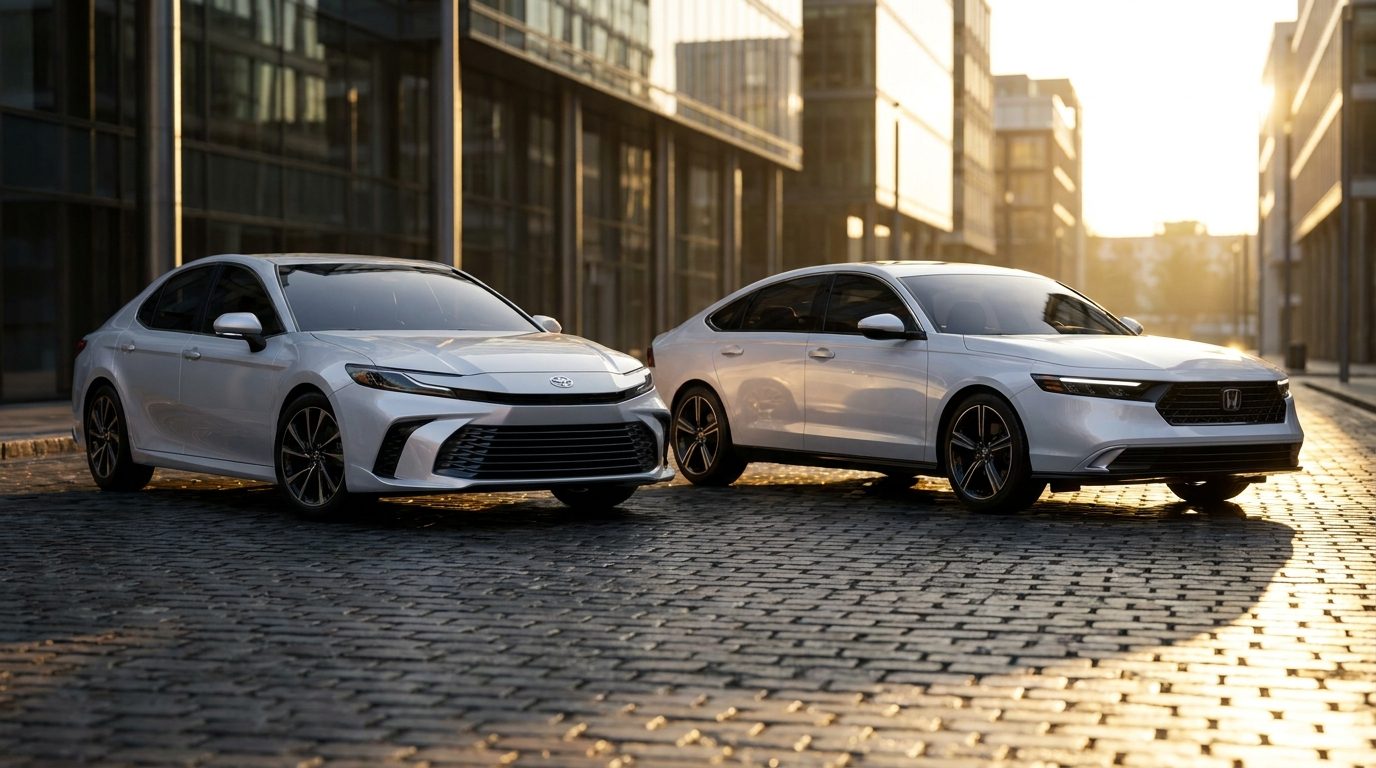
Toyota did not ask permission to make the Camry hybrid-only. They just did it — every Camry, starting 2025, no gas option, no asterisk, no configurator screen where the buyer weighs their options. Toyota weighed the options. The Camry is a hybrid. That's settled.
Then they priced it at $29,300, gave it 225 horsepower and 51 miles per gallon combined, and moved on.
Honda watched this happen and decided to make a better driver's car instead.
This is a legitimate response. The Accord is more engaging to drive, has more rear-seat room, and at $33,795 to start, Honda is asking $4,500 for the experience of actually noticing the car you're in. There is a buyer for whom that is a reasonable exchange.
That buyer is outnumbered. Toyota does not appear to have strong feelings about this.
By the Numbers
| Spec | 2026 Toyota Camry Hybrid | 2026 Honda Accord Hybrid |
|---|---|---|
| Starting price | $29,300 | $33,795 |
| Fuel economy (combined) | 51 mpg | 44 mpg |
| Horsepower | 225 hp (FWD) / 232 hp (AWD) | 204 hp |
| Available AWD | Yes | No — FWD only |
| Driving dynamics | Soft, comfortable, composed | Responsive steering, flatter cornering |
| Rear-seat room | Competitive | More rear-seat space |
| Powertrain options | Hybrid only | Hybrid or gas |
What Toyota Actually Did Here
Going hybrid-only is the kind of product decision that sounds obvious afterward and panics the product team on the way to approval. You are ending the conversation about powertrains for the entire lineup. Anyone who wanted gas-only is now buying a Honda. Toyota made that call and then made the hybrid version cheaper, more powerful, and more fuel-efficient than Honda's dedicated hybrid offering.
The Camry is the correct answer for the largest number of people who are going to buy a midsize sedan. Toyota designed it that way and does not seem particularly troubled by the fact that correct and exciting are not the same thing.
Honda's Actual Case
The Accord has steering that feels connected to something. The front wheels are engaged with what you are doing — responsive and reasonably precise in a way that the Camry's steering is politely not. The ride is firmer through a corner. The Accord rewards the driver who is paying attention. It also costs more, drinks more fuel, has no AWD option, and makes less power.
Honda's argument is that you should drive both of them before you decide. This is true. It is also true that most buyers decide before the test drive, and the one who walks in having read the specs is almost certainly walking out with a Camry.
Honda's bet is that there is a buyer who knows all of this and goes to the dealership anyway. That buyer exists. There are enough of them to keep the Accord in production. They are just not the majority, and the majority is who the Camry was built for.
The Honest Verdict
The Camry buyer ran the numbers before walking in. Better mileage, lower price, more horsepower, AWD available if they need it. They will be completely satisfied with this car and will never once wonder if they made the wrong call. This is not a small thing.
The Accord buyer knew all of this and drove it anyway. They are paying $4,500 more for a sedan that acknowledges them from behind the wheel. They will enjoy the commute. The Camry buyer will not think about the commute, which is a different kind of win and arguably the more sustainable one.
Toyota took efficiency and value. Honda kept the driver. Toyota does not appear to have strong feelings about what they gave up, and based on the sales numbers, they are right not to.
Off-Spec: The Automotive Intelligence Brief
OEM strategy, fleet economics, and the business of how cars actually get sold. No press releases. No puff pieces.