I drove the new Camry to settle an argument I was having with myself. The car looked wrong to me — that pinched hammerhead front end borrowed from the latest Prius, the TRD trim dressed up in racing cosplay, an interior Toyota describes as premium and I would describe as adequate. I wanted to confirm that 316,000 annual buyers were a triumph of brand inertia over taste.
That is not what happened.
Buy it. Not because you will love it. You might not, or at least not in any way you would say out loud. Buy it because it will return 50 mpg without asking anything of you, survive 150,000 miles without a service visit that makes you angry, and resell at a number that makes you feel like the smartest person in the parking lot. Take the XLE. Skip the TRD.
The 2026 Camry is the ninth generation of this car and the first to come exclusively as a hybrid. Toyota did not offer you a choice between the conventional engine and the hybrid system. They made the decision for you, on the theory that if you walked into a Toyota dealership wanting a mid-size sedan, you were getting the right answer whether you asked for it or not. Three hundred sixteen thousand Americans bought one in its first hybrid-only year. That was the strongest Camry sales performance in recent memory. Toyota, apparently, was right.
What It Drives Like
The hybrid system pairs a 2.5-liter four-cylinder with an electric motor for 225 horsepower in front-wheel drive form, or 232 with an added rear motor for AWD. A CVT handles the power delivery, which on paper sounds like the setup for a deeply unsatisfying driving experience. In practice it is not.
The Camry moves with the kind of easy confidence that belongs to something that knows exactly what it is and has no interest in proving otherwise. It is quick. Not exciting-quick, but genuinely quick in a way that makes you realize you have been underselling family sedans in your head. The hybrid system fills in the torque the four-cylinder used to lack, and what you get is a car that keeps up with traffic without effort and merges without drama.
The ride is comfortable in a way that larger luxury sedans work hard to achieve. Nothing rattles. Nothing vibrates. The noise isolation is good enough that you have to make a decision about whether to play music or just listen to the quiet. Steering feel is accurate, communicative, and numb enough that nobody will ever call this a driver's car. That is not a criticism. A Camry buyer is not looking for a driver's car.
The Interior
Here is where my reservations land. The controls are well-placed, the layout makes sense on first contact, and the infotainment system does not actively fight you — which now qualifies as a competitive advantage. Toyota's current dashboard aesthetic is cleaner than what Audi is shipping, but what doesn't look better than what Audi is shipping right now?
The problem is tactile. Touching certain surfaces in the Camry's cabin produces the same sensation I associate with double knit fabric, a material that exists, performs its function, and communicates absolutely nothing enjoyable about the experience of encountering it. This is not a material quality failure. It is a design register failure. Toyota engineered a cabin that meets every objective specification and misses something harder to specify.
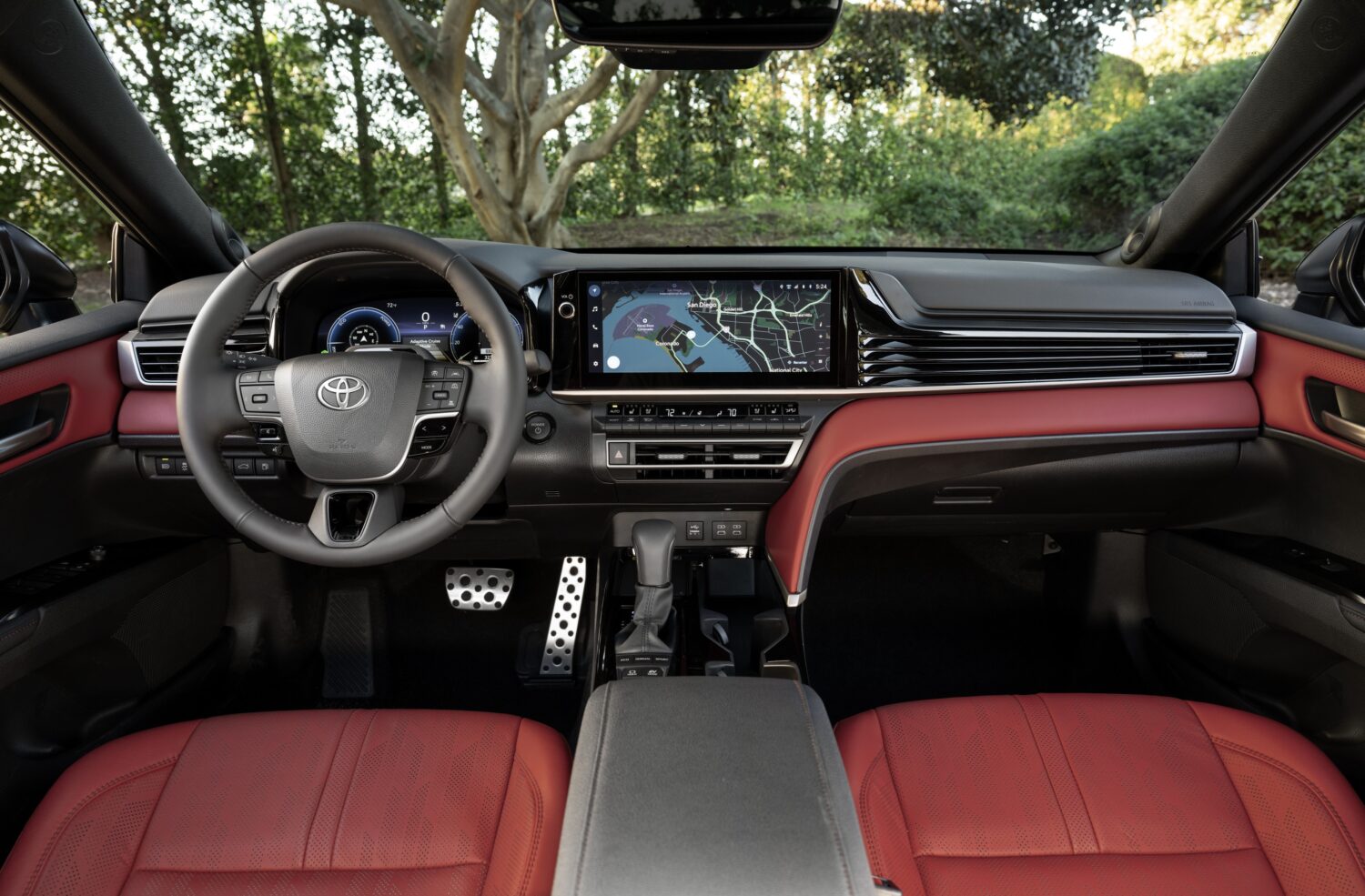 2026 Camry XSE interior — the red leather reads more ambition than the car itself carries. Courtesy of Toyota.
The XLE trim improves this with genuine leather seating and better material choices throughout. The TRD does not improve anything. If you are considering the TRD, understand that you are buying a costume for a sedan that was never built around that premise. The red accents and sport-tuned suspension are not wrong, exactly. They just belong on a different car.
The Prius Problem
There is a specific kind of car that is excellent in every measurable way and never quite shakes what it is. The Prius is the most obvious example. It achieves everything it sets out to achieve, has done so for decades, and millions of people drive one, none of them describing the experience to their friends in a way that sounds like enthusiasm.
The Camry is that car with better looks and a better powertrain. It is still a Camry the way a Prius is still a Prius — exactly what it is, reliably and completely, with nothing left over for anyone who was hoping for something more.
I should say here that I think the Corolla is an excellent automobile. I mean that without irony. It does what a small car is supposed to do with the consistency that explains why Toyota has survived every era of disruption in this industry. The Camry is that same engineering philosophy scaled up and aimed at the center of the market.
I would not own one.
Why 316,000 People Bought One Anyway
The sedan is not dead. The exciting sedan may be — the one that designers took real risks on, that engineers tuned for a back road, that salespeople used to move with a test drive and a story. What is not dead is the sedan that shows up every morning without drama for a hundred and fifty thousand miles.
Toyota proved something with this generation that the industry had been arguing about for years. They made the Camry hybrid-only and did not apologize for it. No conventional engine option, no transition period, no extended consumer research to soften the landing. They decided the hybrid was the correct answer and built the car accordingly. The base trim returned 52 mpg combined. The car posted its best sales year in recent memory.
That is not brand loyalty doing the work. Three hundred thousand buyers did not choose this car because they grew up watching Camry ads. They chose it because the Camry does not fail — not to start, not to deliver its promised fuel economy, not to resell at a reasonable price five years later. In Orange County, where they are everywhere, they belong to people who made a rational decision and have not thought about it since.
You get the same feeling looking at a well-organized closet. Someone made a lot of correct choices, none of them interesting. But Toyota knows something I don't. They know why people love Camrys, and that's good enough for me.
The Numbers
| Base Price | $28,700 + $1,095 destination (LE FWD) |
| Powertrain | 2.5L four-cylinder hybrid, 225 hp FWD / 232 hp AWD |
| Transmission | CVT |
| Fuel Economy | 52 mpg combined (LE FWD) — 44 mpg combined (XSE AWD) |
| Trims | LE, SE, XSE, XLE, TRD |
| Best Trim | XLE |
| Skip | TRD |
If the hybrid thesis holds and you want a different angle on it, the RAV4 Hybrid review and the RAV4 vs. CR-V Hybrid comparison cover the SUV side of the same argument. The Camry is what that argument looks like in a sedan.
Frequently Asked Questions
Is the 2026 Toyota Camry Hybrid worth buying?
Yes, particularly for buyers who want low operating costs, proven reliability, and strong resale value in a mid-size sedan. It is not the most exciting car in the class. It is one of the most sensible. Take the XLE. Skip the TRD.
How does the 2026 Toyota Camry Hybrid perform?
The hybrid system produces 225 horsepower in FWD trims and 232 hp in AWD. Acceleration is strong for a family sedan — noticeably quicker than the previous non-hybrid generation. The CVT keeps power delivery smooth rather than engaging, but it works without complaint in every driving condition.
What fuel economy does the 2026 Camry Hybrid get?
EPA ratings range from 52 mpg combined on the base LE to 44 mpg combined on the AWD XSE. Real-world results in mixed driving typically land within 2 to 3 mpg of the EPA figure, which is better than most hybrid systems deliver consistently.
Should I get the Camry Hybrid or the Honda Accord Hybrid?
The Camry is the more conservative choice — more comfortable ride, more predictable driving character, stronger resale history. The Accord Hybrid is sharper to drive with a more cohesive interior. If you are buying for reliability and long-term value, the Camry. If driving feel is the priority, the Accord makes the case.
Which 2026 Camry Hybrid trim is the best value?
The XLE. It adds genuine leather seating, a larger display, and better material quality without the TRD's performance pretense. The LE is a workable entry point but sacrifices too much interior quality for the savings. The TRD adds cost without adding substance.
Is the 2026 Camry TRD worth buying?
No. The TRD adds sport-tuned suspension and visual changes that do not transform the car's fundamental character. The Camry was not engineered around a performance premise, and the TRD does not change that. If sport matters, spend the money elsewhere in this class.