In high school I bought a Honda Accord hatchback and bolted a set of louvers across the back window. Gold car, saddle interior, black slats sitting at an angle that suggested a Trans Am that had gotten into a decent school. My dad paid for those, of course. The only reason I wanted them was that I wanted the car to be looked at.
I wasn't the first Honda owner in our family, my father went first. A Civic CVCC, and then a Prelude when it arrived carrying that odd stacked dashboard somebody at Honda had clearly designed on a bet. You bought a Honda in those years because they were kind of cool and almost nobody had one. The reliability was something you found out about later, the way you find out you got a good landlord.
Buy the Accord Hybrid if you want an excellent midsize sedan and you don't care whether anyone notices you in it. And get the EX-L because it makes the most of your gallon of gas. It rolls around on 17-inch wheels, returns 48 mpg combined compared to the Sport's 44, and rides better for most of the buyers. You can go ahead and test drive the Sport, just don't say I didn't warn you. The Camry Hybrid is the honest alternative, and it offers all-wheel drive on every trim for $1,525, which the Accord doesn't offer at any price on any trim. Buy the Honda if you do the driving and you like doing it. Buy the Toyota if it snows where you live.
Honda Built the Caprice
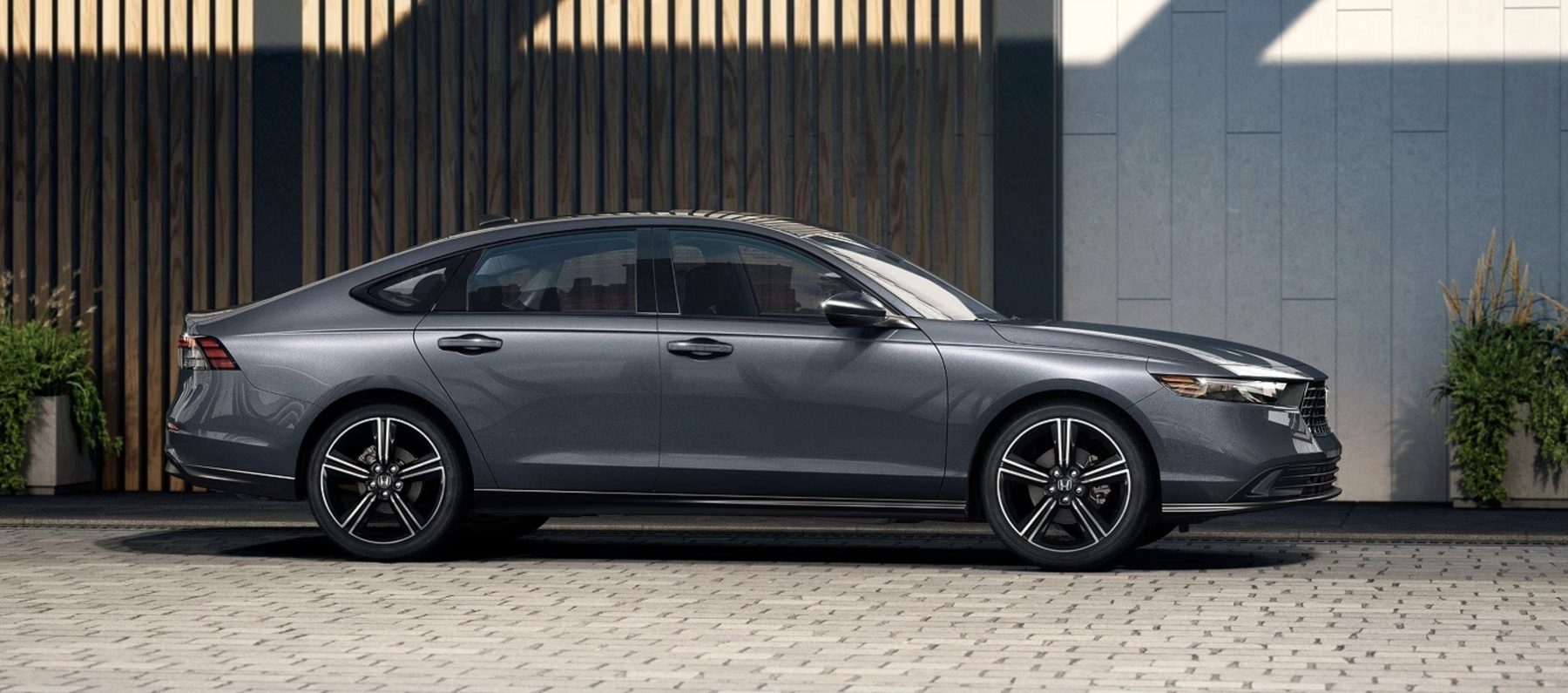
The current Accord is long and low with a big greenhouse and flanks that don't interrupt themselves. In a dark color it reads as a scaled-down Audi. In most colors it reads as a very well-made American full-size sedan from 1992, which is the more useful comparison, because that's what the car has become.
The Accord and the Camry are the Ford LTD and the Chevrolet Caprice of our time. They are the default. They are what you buy when you have decided not to spend any more of your life thinking about this particular decision, and there is nothing wrong with that. Smart millionaires drive them. The person who quietly owns four rental properties isn't in a Wagoneer.
My most recent checks show Toyota sold 317,185 Camrys last year against Honda's 150,196 Accords. That's roughly the volume ratio the Chevrolet and Ford divisions used to argue about. Over half of Accord sales in 2025 were hybrids. This is a mass-market appliance sold at mass-market scale, engineered by people who understand exactly what they are building. I've sung the praises of Toyota's leadership in staying with hybrids when everyone seemed to bow at the altar of the EV, but Honda deserves their own applause. They know who their buyers are.
But, I am not the buyer of either the Accord or Camry. I want a car that has an opinion about corners, and these guys are arranged to have as few opinions as possible about anything. And that's really a preference and not some kind of mistake.
It's Much Better Than It Needs to Be
The hybrid system pairs a 2.0-liter Atkinson-cycle four with two electric motors for 204 horsepower and 247 pound-feet. Thanks Honda, to all that is Holy, there's no continuously variable transmission in there. Most of the industry calls this thing an eCVT. Honda's own spec sheet doesn't. It says Direct Drive Unit, and it saves the words continuously variable for the gas four-cylinder, which is a distinction somebody at Honda fought for and that person deserves a raise.
Here is what it actually does. Off the line the engine is off and the battery feeds the traction motor. Through most of the middle of the range the engine runs but never touches the wheels, spinning a generator at whatever rpm it likes best while the motor does the driving. At a steady highway cruise a clutch locks the engine to the wheels and the electricity gets out of the way. Honda then uses software to fake gear steps so the thing doesn't sit at one screaming rpm the way a real CVT does.
The practical result is that it doesn't do the rubber-band thing. Power arrives when you ask and it doesn't announce the mechanism because, you know, the car doesn't want attention. It just does its thing really well.
Well, it does everything well except maybe hustle down the road. You don't get the Accord to be a getaway vehicle. I didn't track the time when getting onto the 5, but it was quick enough. Consumer Reports got 8.0 seconds to 60 in a Sport. Edmunds got 7.0 in a Sport-L. Both are fine and focusing on a 0-60 misses the point of the car.
The steering is light and accurate, which is the Honda standard and has been since the CVCC. The car turns in without argument, holds a line, and rides quietly. Consumer Reports called the controls its new favorite, largely because Honda went against the screen virus infecting the industry and kept actual knobs for the climate system while the rest of the industry was busy burying that function three menus deep. The trunk is 16.7 cubic feet with no battery penalty, a cubic foot and a half more than the Camry, which is a useful advantage you can mention to your Camry friends.
Everything in there works. The switchgear feels like a Honda in a lovingly expected way. The interior is better than the Camry's and better than it has to be at this price, which is the part of the company that has not changed. I'm not saying Honda is perfect and wouldn't decontent interiors if it had to, my experience says they see quality as a character trait.
The Hybrid Trims, Side by Side
| Spec | Sport | EX-L | Sport-L | Touring |
|---|---|---|---|---|
| Price, excl. $1,195 destination | $33,795 | $35,095 | $35,495 | $39,495 |
| EPA combined | 44 mpg | 48 mpg | 44 mpg | 44 mpg |
| EPA city / highway | 46 / 41 | 51 / 44 | 46 / 41 | 46 / 41 |
| Wheels | 19-inch | 17-inch | 19-inch | 19-inch |
| System output | 204 hp / 247 lb-ft, 2.0L Atkinson four plus two motors | |||
| Drive | Front-wheel drive. No all-wheel drive at any price. | |||
| Touchscreen | 12.3-inch on all hybrid trims. 10.2-inch digital cluster. | |||
| Trunk | 16.7 cubic feet, no battery penalty. Camry is 15.1. | |||
| Google built-in | — | — | — | Standard |
| Safety | IIHS Top Safety Pick. Not TSP+, held back by an Acceptable rating on vehicle-to-pedestrian front crash prevention. NHTSA has not rated the 2026. | |||
Where It Gives Up
Honda makes some great seats. You see them in the Acura, the Type R of course, and even the Odyssey. So it's surprising that the Accord's front seats suck. And my Audi conditioned butt isn't the first to say so. Consumer Reports (of all places) called them the car's biggest letdown, described the sensation as sitting in a hole, and found the padding gave up on drives that were not even long. Hahahaha, Consumer Reports said that! It's as if your grandma threw some shade on the seats. Edmunds arrived at the same complaint independently. For a car whose entire proposition is spending several hours in it without incident, that's a strange thing to get wrong. And back to my comment earlier about decontenting, the seats are the worst place to lose focus.
Oh, and unless you want to feel every bump, 19-inch wheels cost you twice. The EX-L runs 17s and returns 48 mpg combined. Everything else runs 19s and returns 44. Consumer Reports found the same thing, that the 19s let sharp bumps punch into the cabin on a suspension that otherwise handles pavement well. The Accord isn't the only car like that. Put low-profile 19s on any vehicle, and the same thing happens. You are paying four miles per gallon and some ride quality for a wheel that looks better in the configurator.
The other thing I miss, because I drive an Audi, is the lack of all-wheel drive. It's not on the Sport, not on the Touring, not for extra money. The Camry will sell it to you on any grade for $1,525. If you live somewhere with weather, that may end the conversation before the driving dynamics get a vote.
And, before you head to the dealership, 2026 isn't a design refresh for the Accord. There were a few things that changed for the good, though. Base screens went to nine inches, wireless CarPlay and a wireless charger became standard on every trim, the SE got 19-inch wheels, and Honda blacked out some trim on the Sport. Base price went up about a hundred dollars. Calling this a model year is a courtesy but no one is going to complain about wireless charging and bigger screens.
Honda Will Sell You the Other Car for $8,200
If my dad were alive, he'd be happy the Prelude came back. It has been on sale since last November at $43,195 delivered, one configuration, no trim ladder, borrowing suspension and brake pieces from the Civic Type R.
It makes 200 horsepower. The Accord Hybrid Sport makes 204. The Prelude returns 44 mpg combined. The Accord Hybrid Sport returns 44 mpg combined. Same two-motor hybrid system, four horsepower apart, identical fuel economy, and eight thousand two hundred dollars between them. But the Prelude isn't an Accord. That is the entire eight thousand two hundred dollars.
Honda knows precisely what the Accord is. They built a car for the other customer and Honda is positive that customer will buy it. Eight grand is what it costs to be looked at, and I find that a reasonable price, having once paid for louvers.
The Case Against Me
Sam Abuelsamid wrote in January that the Accord Hybrid deserves your attention, and he is right about the car. He says Honda's hybrid feels closer to driving an EV at low speeds than Toyota's does, that it's quieter and more refined, and that it's more fun on a daily basis than the Camry. All true. I made the same argument in my own comparison three weeks ago and I am not withdrawing it.
Where we part company is on why nobody notices. He puts it down to the midsize segment collapsing and the Civic eating the Accord's lunch inside Honda's own showroom. That Civic cannibalization is real. But it's also not the whole thing. This car isn't overlooked because the category shrank. It is overlooked because it was engineered to be, by a company that has gotten extremely good at removing every reason to look twice.
So let's settle it here. Through July, Accord sales are up 36.1 percent year over year while the Camry is up 14.9. The car built to disappear is the one moving fastest. Being unmemorable turns out to be a product strategy, and Honda is executing it about as well as anyone ever has. And in my eyes, the Accord looks a lot better than the Camry.
I might still put the louvers on.
Off-Spec: The Automotive Intelligence Brief
OEM strategy, fleet economics, and the business of how cars actually get sold. No press releases. No puff pieces.