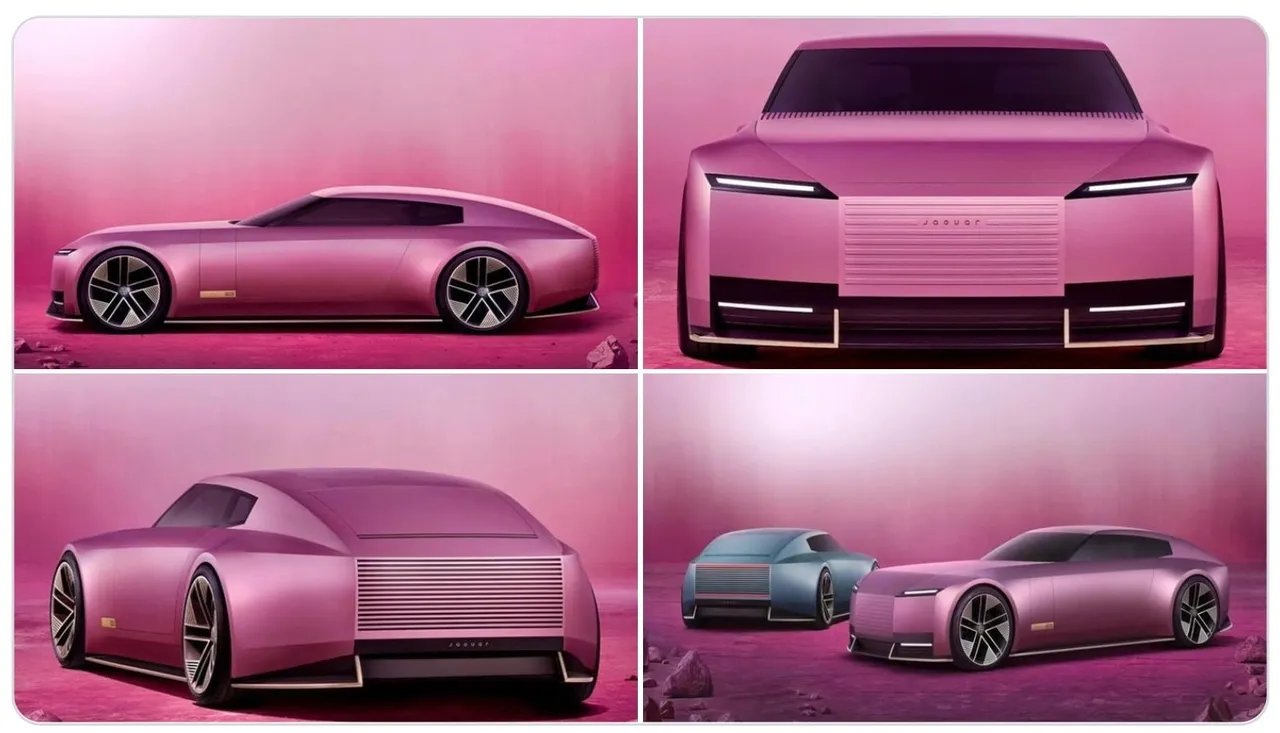
Remember when Derek Zoolander introduced Derelicte — his fashion line inspired by "the beauty of trash"? Jaguar's recent rebrand is the automotive equivalent. Except with less irony and a bigger marketing budget.
The once-iconic British brand, known for elegance and genuine sporting character, decided that being really, really, ridiculously good looking was overrated. Instead they gave us a Miami Pink concept car that looked like a Barbie dream car rendered by someone who failed geometry — and an ad campaign featuring exactly zero automobiles.
I swear I could hear Mugatu yelling, "Doesn't anyone notice this? I feel like I'm taking crazy pills!"
The Rebrand Nobody Asked For
Out went the iconic leaping jaguar. In came a "funky" new logo that belongs on a nightclub flyer, not a luxury automobile. Then came the Type 00 concept — shown in Miami Pink and London Blue — a two-door fastback with butterfly doors, a sealed front grille, no rear window, and brass interior spines. Unveiled not at an auto show but at Miami Art Week, because Jaguar's managing director declared that "art is a passion point for the types of customers the brand wants to attract."
The customers they already had? Apparently not a passion point.
Being different only works if it's also, you know, good.
Jaguar's problem was never that it was boring or outdated. It was that the brand had drifted from its sporting soul. The solution to that isn't a pink concept car unveiled next to a Bugatti at an art fair. It's making cars that earn the badge again. Jaguars used to be aspirational — cars that turned heads and set pulses racing. The rebranding turned the brand into a parody of itself.
The Year That Followed
The twelve months since this launched have been genuinely rough. Jaguar deliberately halted all sales in 2025 to clear inventory ahead of the new lineup — so the company generated essentially zero car revenue for an entire calendar year. A cyberattack hit JLR's operations and shut down production for months. The design chief Gerry McGovern, the man behind the entire rebrand, was escorted out of the building in December 2025 with his contract terminated immediately. The University of Birmingham called it "a symbolic end of an era." Tata, which owns JLR, appears to be reasserting control.
On paper, it looks like a catastrophic unraveling. In practice, it might be a course correction happening faster than anyone expected.
But Here's the Thing
The actual production GT — the real car, not the concept — has now been seen by select British press. The reviews from people who've ridden in it use words like "striking" and "stunning." It's no longer pink. It has frameless doors and a commanding driving position. The shape is still related to the Type 00, but toned down into something that resembles a real grand tourer rather than a concept car that was never meant for production.
The specs, if they hold, are serious: up to 1,000 horsepower, 430 miles of EPA range, 200 miles added in 15 minutes of fast charging, built on a bespoke platform in the UK, priced above £100,000. That's not trying to compete with the Germans. That's going straight at Bentley and Rolls-Royce.
It's an extraordinarily high-wire act. Jaguar burned its existing customer base, spent a year with no product to sell, fired its design chief, and is now betting the entire company on a single ultra-luxury EV in a market that is, to put it charitably, complicated right now. If the car lands well, they might thread the needle. If it doesn't, there may not be a second chance.
You can survive a bad rebrand. You cannot survive a bad car.
I still think the pink Miami launch was a strategic disaster. The brand alienated decades of loyalty chasing customers who haven't shown up yet. That's a real cost with a long tail. But I'm willing to revise my verdict on the production car when it actually arrives — because "striking" from Evo and "stunning" from The Independent aren't words those publications hand out to cushion bad news.
Maybe Jaguar found something on the other side of all this wreckage. We'll see in 2026.