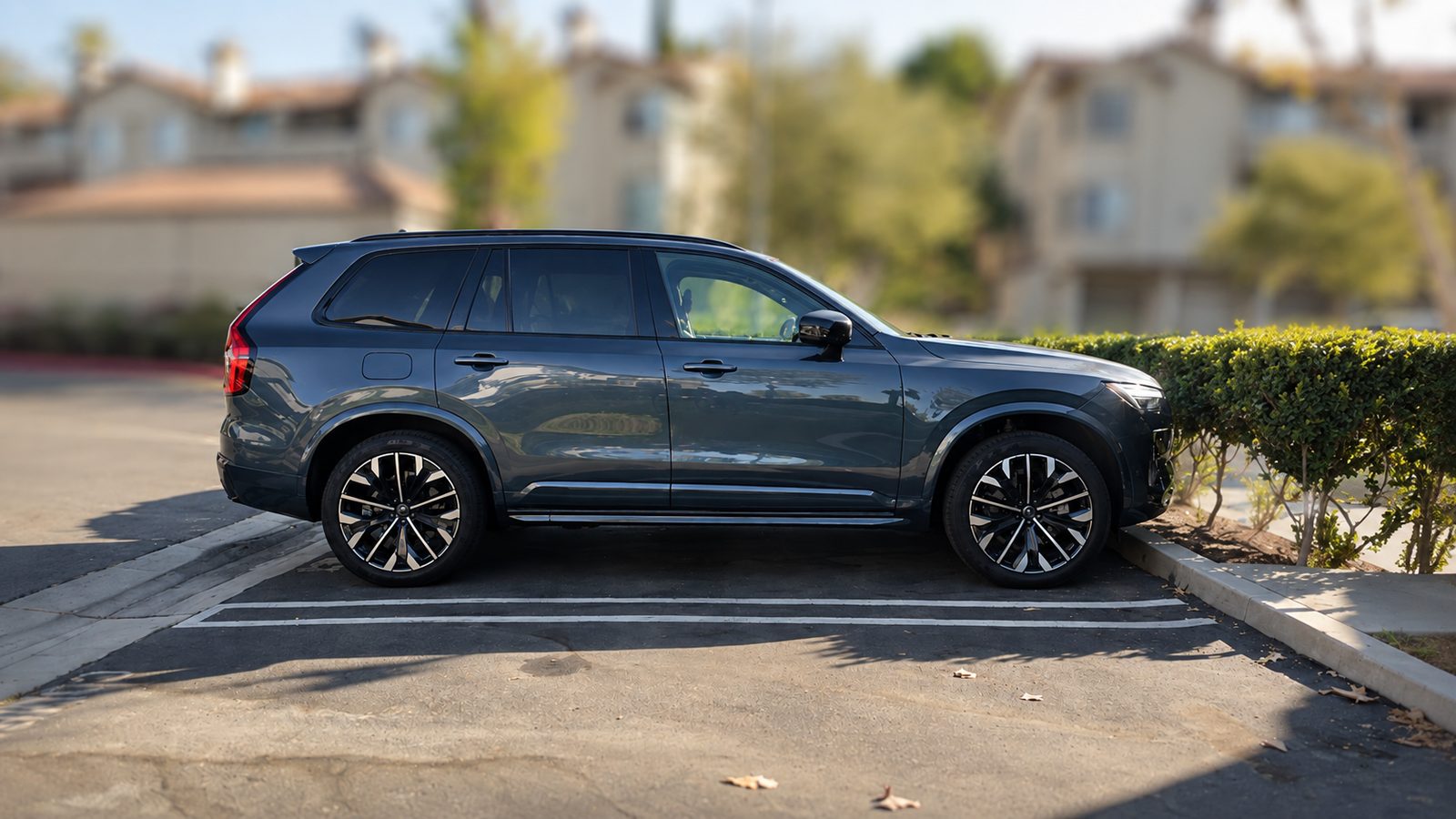
A neighbor of mine got rid of a nearly new Toyota Sequoia. Not a tired one. A recent one, the full-size three-row with the twin-turbo hybrid V6, the truck Toyota built to end the argument about full-size SUVs. She replaced it with a Volvo XC90 B6 Ultra and hasn't looked back once.
I haven't driven her car. She drives it every day, which for the purposes of this review makes her the more useful person to talk to. The measured numbers below come from Car and Driver's long-term test of the same vehicle. The opinions come from a woman in her early forties who works from home, has three kids, and spent real money on this decision.
The B6 earns its $67,545 to $74,745 on the seats and the cabin. The catch is the badge. It is a 48-volt mild hybrid, so it cannot move on electricity at all, and the third row eats the cargo hold down to 10.6 cubic feet, which will not take four people anywhere for a week. Worth the money for the interior, not for the drivetrain.
Her shopping list is the interesting part. She looked at an Audi Q6 e-tron and walked. Her complaint was the interior, which she found cheap, and the flat-panel dash, which she disliked on sight.
She isn't alone in the first one. Carwow's Mario Christou wrote about "nasty, scratchy plastics" under the soft-touch surfaces, and Autocar's tester found "too many hard and shiny materials for the price." Audi has since skipped the 2026 model year in the United States entirely, going from 2025 stock straight to an early 2027.
She also looked at a GMC Acadia, because a friend had one. That isn't how buff books think people shop, and it's exactly how people shop.
She liked the space, and the space is real. At $45,795 with destination the Acadia undercuts the Volvo by more than twenty thousand dollars, seats up to eight, and gives you 23.0 cubic feet behind the third row against the Volvo's 10.6. She bought the Volvo anyway, which tells you the Acadia was never really in it.
What she wouldn't do again
She wouldn't buy another EV. Her household already has one, a Kia Niro EV, and before that a Tesla Model 3. Her husband charges his at work. There's no charger at their house.
That's the whole reason.
Not range anxiety in the abstract, not a position on batteries, not anything she read. She didn't want to think about where the car gets its electricity. Every EV pitch ever written assumes a garage outlet and a person who enjoys planning. She has three children and no home charger.
She pays more for fuel now. She also doesn't drive much, which makes the arithmetic she was warned about mostly theoretical.
The hybrid she thinks she bought
Hybrid was at the top of her list. She likes how the system in the Volvo works. I have to be careful with her here, because she's right about the car and wrong about the label.
What she has is a 48-volt mild hybrid. A 2.0-liter four, turbocharged and supercharged, making 295 horsepower and 310 lb-ft, with a small motor-generator that smooths the stop-start, fills a little torque off the line, and recovers some energy under braking.
It cannot move the car on electricity. Not for a block, not across a parking lot, not ever. The Sequoia she traded was a full hybrid and her Kia is a real EV, which makes the Volvo the odd one out in her own driveway.
None of which makes her wrong. Sort out what she actually asked for and the B6 delivers all of it. She wanted no charging, no plug, no planning, and a drivetrain that feels quiet and unhurried the way people expect a hybrid to feel. That's what a 48-volt system is for.
The word "hybrid" has drifted. It used to describe how a car makes motion. It now mostly describes how a car behaves while making it, and she bought the behavior on purpose. I've argued before that hybrids won the drivetrain argument, and this is the strange second act, where the word stops meaning one specific thing.
The EPA says 20 city, 26 highway, 23 combined. Car and Driver saw 22 mpg across 10,000 miles and a 410-mile tank. Her Sequoia, in four-wheel drive, was rated 20 combined. She gained three miles per gallon and lost the ability to drive on electricity, and she considers this a good trade because she never used the second part.
If she'd wanted the real thing, Volvo sells it. The T8 plug-in makes 455 horsepower and covers 33 miles on the battery. It also starts at $77,595 and climbs to $84,795 in Ultra trim, which is ten thousand dollars past what she paid, and it needs the charger she doesn't have.
Everything Car and Driver disliked, and why none of it reached her
Car and Driver has run an XC90 B6 Ultra for 10,000 miles and published a list of grievances. I read her the list. She had no issue with any of it.
The ride is unsettled on rough pavement. Technical editor Mike Sutton called the infotainment "hot garbage" and complained about cryptic steering-wheel controls and wonky phone mirroring. Apple CarPlay and Android Auto are wired only, on a $74,745 vehicle, in 2026.
The third-row seats have no handles or straps, so putting them up is a fight. You can't defeat traction control, there's no sport mode, and for a while the start-stop couldn't be switched off either, though a software update has since fixed that one.
Every complaint on that list is a complaint about driving the car. Ride quality on bad pavement matters at speed. Traction control defeat matters when you want to steer with the throttle.
Sport mode matters to somebody who wants a different throttle map on a road they've chosen for the purpose. Phone mirroring matters most to a person who gets into a different test car every week and has to re-pair a phone every Monday.
She does a school run and a grocery trip. She has never once wanted to unstick the back end of a 4,626-pound Swedish station wagon on stilts. She plugs the cable in and leaves it there, and she puts the third row up a few times a year.
The one gripe that could have reached her, the non-defeatable start-stop, got fixed over the air before it became her problem.
The buff books and the buyer are evaluating two different products with the same badge on them. Only one of those evaluations gets made at the dealership.
What she actually bought it for
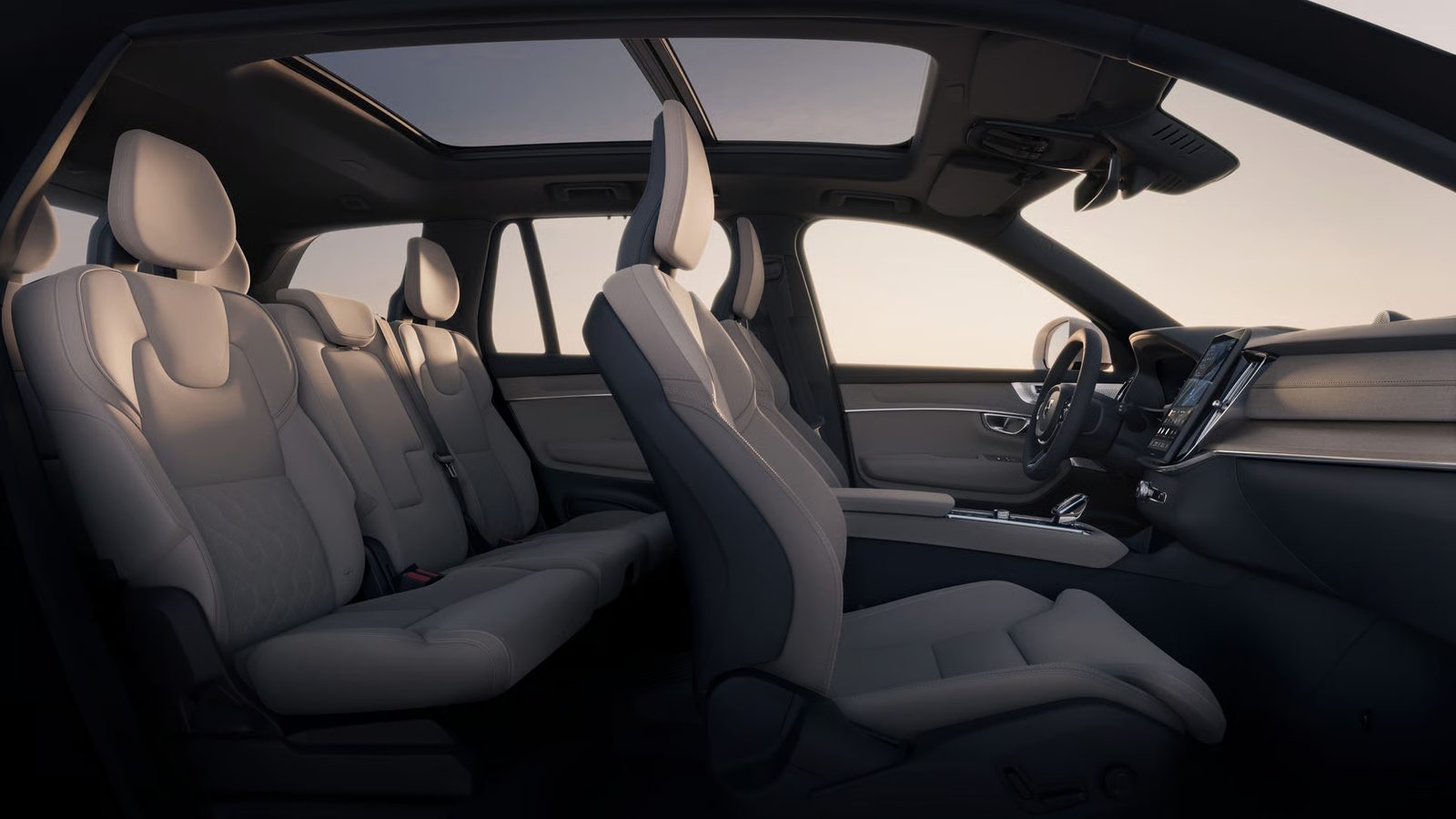 2026 Volvo XC90 interior. Photo courtesy of Volvo Cars.
The seats. Heated captain's chairs in the second row, and front seats that Car and Driver's editor-in-chief Tony Quiroga called "best in the biz," which is the one point where the magazine and my neighbor agree completely.
The instrument panel. She wanted a real one, meaning a display in front of the driver rather than everything shoveled onto a slab in the middle of the dash. That's the same objection she had to the Audi, and the Q6 e-tron does have a driver cluster. She still hated the way it looked.
Buyers reject the aesthetic, the engineers hear a spec complaint, and that is how you end up with three screens nobody asked for.
The interior quality, which is the thing Volvo has never stopped being able to do. The way it looks, which she volunteered before I asked. And safety, which is the reason anybody has ever bought a Volvo and is still the reason.
On that last one, the numbers deserve a footnote. The 2026 XC90 is an IIHS Top Safety Pick, not a Top Safety Pick+. It scores Good on the crash tests and Acceptable on front crash prevention and on LATCH, and the Acceptable scores are what keep the plus sign off it.
NHTSA hasn't rated the 2026 at all, though the 2025 earned five stars overall.
The Volvo that did take Top Safety Pick+ this year is the EX90. The electric one she didn't want.
The things she declined to worry about
Volvo's EV had a problem in this market. The United States moved to bar vehicles running Chinese-developed connected-car software, and Volvo, majority owned by Geely, was squarely in the blast radius.
On May 26, 2026, Commerce granted Volvo a specific authorization to keep importing and selling here. Polestar didn't get the same treatment. She knew a version of this story and didn't care.
Volvo is also having a hard time. It sold 710,000 cars in 2025 and posted a net loss of 4 billion kronor against that. Then it cut 3,000 jobs. Sales in the Americas fell 28 percent in the first quarter of 2026, and the EX90 arrived late and buggy and took an 11.4-billion-kronor write-down with it.
None of which appears anywhere on the window sticker.
She didn't care about that either, and she isn't being naive. She's buying a vehicle with a warranty, not equity in a Swedish carmaker. The financial press and the person in the showroom have never once been shopping for the same thing.
Should you buy one
If you want a three-row luxury SUV, have no home charger, and value the interior over the driving, the B6 is a genuinely good answer at $67,545 to $74,745. Get the Ultra if the seats matter to you, and the seats are the best thing about the car.
If you want the third row to work for adults, buy something else. Ten and a half cubic feet behind it is a grocery run, not a vacation. If you enjoy driving enough to have opinions about throttle maps, buy something else. If you have a charger at home and forty thousand annual miles, the T8 makes more sense and you'll save the difference eventually.
And if what you actually want is the word "hybrid" on the tailgate and the behavior that comes with it, the B6 does that, and you should know exactly what you're getting when you sign. My neighbor didn't know, and it wouldn't have changed her mind.
Off-Spec: The Automotive Intelligence Brief
OEM strategy, fleet economics, and the business of how cars actually get sold. No press releases. No puff pieces.