Rivian's headquarters is in Irvine, about ten minutes from me on the 241. The R1S has been showing up in driveways around my neighborhood since 2022 — not as frequently as the Cybertruck, which is apparently what you buy when subtlety is not a priority, but enough to take notice. For the past two years I have been forming opinions about a vehicle I had not yet decided to buy.
The R1T pickup always struck me as something designed with a Ford engineer in the room voting loudly on proportions. The R2 is a different situation. Rivian announced it last year at a starting price that made sense, showed us a shorter, broader-shouldered design that actually hangs together as a proportion, and last month they started delivering. It is now an actual vehicle you can actually buy, which means it is time to figure out which version to get, and why one specific gas-powered alternative deserves a look before you place the order.
Buy the R2 Premium at $53,990 — dual-motor AWD, 330 miles of EPA-rated range, and the interior features that make a $54,000 vehicle feel like it costs $54,000. Skip the Performance trim unless 656 horsepower in an SUV is a specific requirement, which for most people it is not. Skip the Standard trims if you want delivery this year or AWD — they arrive in 2027, both rear-wheel drive only. The 2025 Toyota Land Cruiser starts at $56,700 with a 6,000-pound tow rating, mechanical locking differentials front and rear, and 70 years of demonstrated off-road capability. If you are EV-adjacent rather than EV-committed, run that comparison before you order.
Rivian R2 Trim Breakdown
The R2 comes in four configurations. Two exist as vehicles you can buy now or within the next few months. Two are a year or more out.
| Standard SR | Standard LR | Premium ★ | Performance | |
|---|---|---|---|---|
| Price | $44,990 | $48,490 | $53,990 | $57,990 |
| Motor / Drive | Single / RWD | Single / RWD | Dual / AWD | Dual / AWD |
| Horsepower | 350 hp | 350 hp | 450 hp | 656 hp |
| Torque | 355 lb-ft | 355 lb-ft | 537 lb-ft | 609 lb-ft |
| 0–60 | TBD | TBD | 4.6 sec | Under 3 sec |
| Range | TBD | 275 mi* | 330 mi (EPA) | 330 mi (EPA) |
| Towing | TBD | TBD | 4,400 lbs (w/pkg) | 4,400 lbs (incl.) |
| Delivery | Summer 2027 | Early 2027 | Late 2026 | Now |
* Rivian estimate — not an EPA rating.
The Performance trim at $57,990 makes 656 horsepower and 609 pound-feet of torque and will do 0 to 60 in under three seconds. Rivian is including a Launch Package with early-delivery Performance orders that adds Autonomy+ hands-free driving for the life of the vehicle, no subscription required. That matters if you commute on the 405. The semi-active suspension is genuinely useful off-road and better-behaved than a standard passive setup at speed. None of this changes the basic math: the Performance trim costs $4,000 more than the Premium for capability most buyers will not regularly use.
The Premium at $53,990 is the trim. Dual-motor AWD, 450 horsepower, 537 pound-feet, 0 to 60 in 4.6 seconds, 330 miles of EPA-rated range. Heated and ventilated seats front and rear. Both front seats 12-way power-adjustable. Nine-speaker Premium Audio. Rear drop glass. Matrix LED headlights. Rivian also builds a Torch flashlight into the driver door, which sounds like a marketing touch and turns into something you reach for every time you back into a campsite after dark.
The Standard LR at $48,490 is single-motor, rear-wheel drive, and delivers approximately 275 miles of range by Rivian's own estimate — not an EPA rating. That distinction matters; Rivian-estimated figures tend to run optimistic. It arrives in early 2027. A smaller-battery Standard SR at $44,990 follows in summer 2027, with full specs still unpublished. Both Standard variants make sense if your daily driving is under 200 miles, you have a place to charge at home, and you can wait until next year. Know whether that describes you before you configure one.
Every R2 comes with a NACS port, which means access to Tesla's Supercharger network from day one. Ten to 80 percent in about 29 minutes at a DC fast charger. In South Orange County, that is not a difficult number to work with.
Off-Road Specs
| Ground Clearance | 9.6 inches |
| Approach Angle | 25° |
| Breakover Angle | 20.6° |
| Departure Angle | 26° |
| Wading Depth | 19.7 inches |
| Wheelbase | 115.9 inches |
| Overall Length | 185.9 inches |
| Cargo (max, incl. frunk) | 90.1 cu ft |
These are respectable numbers for a mass-market SUV that is not pretending to be a Wrangler. The electric powertrain has a real off-road advantage in the right conditions — instant torque delivery and per-wheel control through the dual-motor AWD system handles the kind of moderate trail work most people actually do, meaning the unpaved road to a campsite rather than anything on a spotter line. The approach and departure angles are competitive for the segment.
Where EV torque vectoring runs short is in deep, sustained crawling on technical rock. For that kind of work, a mechanical locking differential is a more confident answer than software interpreting wheel slip. The Land Cruiser has mechanical locking differentials. The R2 does not.
The Land Cruiser Has Something to Say
The 2025 Toyota Land Cruiser starts at $56,700 in its 1958 trim. That is $2,710 more than the R2 Premium.
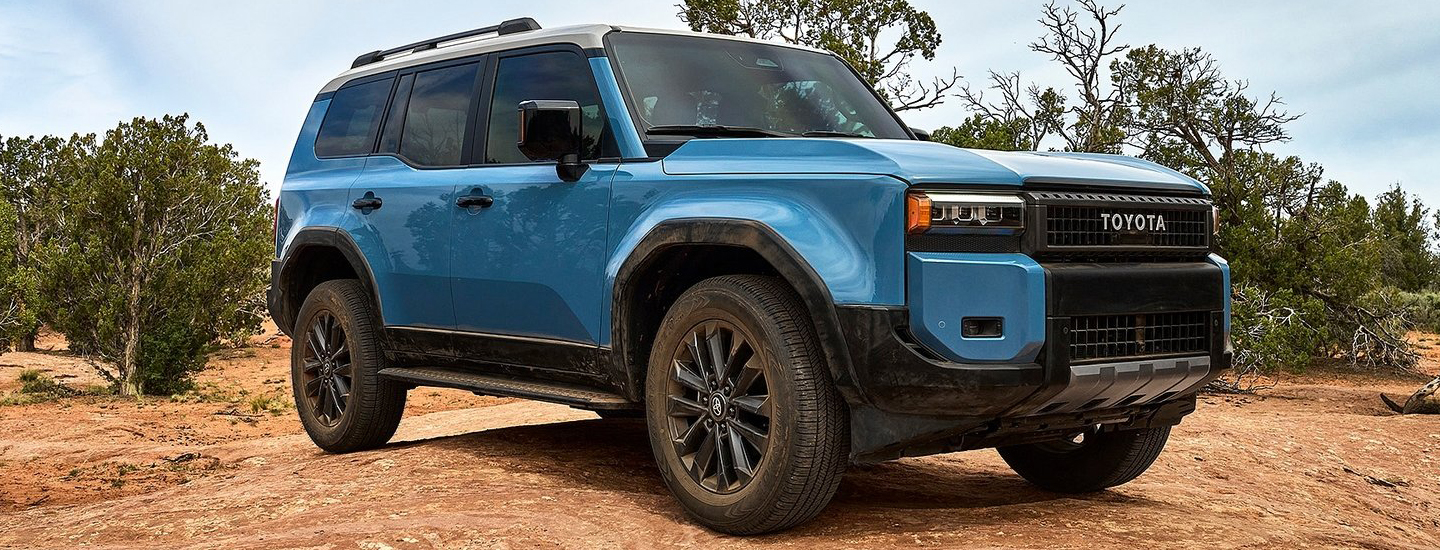 2025 Toyota Land Cruiser 1958 trim. Photo: Toyota.
| Rivian R2 Premium | Toyota Land Cruiser 1958 | |
|---|---|---|
| Price | $53,990 | $56,700 |
| Powertrain | Dual-motor AWD (electric) | 2.4L twin-turbo hybrid, full-time 4WD |
| Power | 450 hp / 537 lb-ft | 326 hp / 465 lb-ft |
| Range / Efficiency | 330 mi (EPA) | 22 city / 25 hwy mpg |
| Towing | 4,400 lbs (w/pkg) | 6,000 lbs |
| Ground Clearance | 9.6 in | 8.3 in |
| Approach Angle | 25° | 30° |
| Departure Angle | 26° | 22° |
| Overall Length | 185.9 in | 194.9 in |
| Max Cargo | 90.1 cu ft (w/frunk) | 82.1 cu ft |
| Locking Diffs | Electric torque vectoring AWD | Locking center + rear diff (standard) |
| Charging | 29 min, 10–80% (NACS) | Fill up anywhere gas is sold |
The Land Cruiser runs a 2.4-liter twin-turbo hybrid making 326 horsepower and 465 pound-feet of torque. Less power than the R2 Premium on both counts, and it returns real-world fuel economy somewhere between 19 and 21 miles per gallon. The tow rating is 6,000 pounds with the factory package — 1,600 more than a tow-equipped R2. The approach angle at 30 degrees beats the R2's 25 degrees. The departure angle at 22 degrees does not.
Every Land Cruiser comes standard with full-time 4WD, a locking center differential, and a locking rear differential. The 1958 trim also includes a 2,400-watt inverter — the detail that tells you someone on the engineering team went camping before they finished the spec sheet. The Land Cruiser trim adds Multi-Terrain Select with six modes: Auto, Dirt, Sand, Mud, Rock, and Deep Snow. Higher trims add a front stabilizer bar disconnect for greater wheel articulation on technical terrain.
At 194.9 inches, the Land Cruiser is nine inches longer than the R2. In South Orange County, nine inches matters in a parking structure and on a tight fire road. The R2's smaller footprint is a real daily-use advantage for anyone who has tried to fit a body-on-frame SUV into a multi-level structure in Newport Beach.
The cargo math runs close: 82.1 cubic feet maximum in the Land Cruiser, 90.1 in the R2 when you include the 5.2-cubic-foot frunk. The R2 wins on paper. Whether the frunk figures into your actual usage pattern is worth being honest about before you count it.
I have been looking at the R2's headlights for several months. The DRL treatment still does not work for me. I understand the design intent. It reads as busy against an otherwise clean profile, and it is the thing I keep coming back to every time I see one in traffic. The Land Cruiser's face is less interesting and considerably less distracting.
The EV-adjacent question reduces to two different sets of promises. The R2 is asking you to trust that charging infrastructure is solved, that 330 miles of EPA range covers your actual week, and that electric torque is worth more to you than 6,000 pounds of towing and mechanical differential locks. In South Orange County, the charging argument holds up. Superchargers are not hard to find. The anxiety that would stop someone in rural Idaho from buying an EV is largely theoretical here.
The Land Cruiser is asking you to trust 70 years of demonstrated reliability, a powertrain that operates anywhere gas is sold, and the engineering judgment of people who made mechanical differential locks and a 2,400-watt inverter standard equipment before asking you to pay extra.
Neither of those promises is wrong. Where you drive, what you tow, and how patient you are with a charging infrastructure are the deciding variables. The R2 Premium is the trim. Run the number against the Land Cruiser 1958 before you order. If you want the hybrid SUV comparison on the sedan side, the Camry Hybrid review covers what Toyota is doing when the off-road question is off the table. And if you are writing content for OEM or fleet EV programs, the piece on what happened to the EV buyer persona is the context that makes this purchase conversation make sense.
Frequently Asked Questions
Which Rivian R2 trim should I buy?
The Premium at $53,990. It gives you dual-motor AWD, 450 horsepower, 330 miles of EPA-rated range, heated and ventilated seats both rows, 12-way power both front chairs, nine-speaker audio, Matrix LED headlights, and rear drop glass. The Performance trim costs $4,000 more for capability most buyers will not regularly access. The Standard variants are rear-wheel drive and do not arrive until 2027.
Is the Rivian R2 good off-road?
Yes, for moderate off-road use. The R2 offers 9.6 inches of ground clearance, a 25-degree approach angle, 26-degree departure angle, and 19.7 inches of wading depth. The dual-motor AWD uses electric torque vectoring for traction control. It does not have a mechanical locking differential, which puts it at a disadvantage in sustained technical rock crawling compared to the Toyota Land Cruiser.
How does the Rivian R2 compare to the 2025 Toyota Land Cruiser?
At similar price points — R2 Premium at $53,990 versus Land Cruiser 1958 at $56,700 — the R2 offers more horsepower, better cargo volume, a shorter overall length, and Supercharger network access. The Land Cruiser counters with a 6,000-pound tow rating versus the R2's 4,400 pounds, mechanical locking differentials front and rear, a 30-degree approach angle versus the R2's 25 degrees, and 70 years of off-road track record. Towing requirements and charging infrastructure access are the deciding variables.
Does the Rivian R2 have a locking differential?
No. The AWD models use electric torque vectoring — the dual-motor system distributes power between axles and wheels to manage traction. This works well for moderate off-road conditions and is not the same as a mechanical locker. The 2025 Toyota Land Cruiser has both a locking center differential and a locking rear differential as standard equipment on every trim.
When does the Rivian R2 Standard trim arrive?
The Standard Long Range at $48,490 is scheduled for early 2027. The Standard with a smaller battery at $44,990 follows in summer 2027. Both are single-motor, rear-wheel drive. The 275-mile range figure Rivian cites for the Standard LR is the company's own estimate, not an EPA rating. Full specs for the smaller-battery Standard have not been published.