You drive a 2019 RAV4. It has been fine. You bought it because it was the default good-enough SUV every sensible person ends up in eventually, and for seven years it has done what you needed it to do, which is go places and not break. My son drives a fifth-generation RAV4 for exactly the same reasons. Millions of people do.
So you walk into a Toyota dealer thinking you'll trade up to whatever the 2026 version of your car is. Except the 2026 version of your car does not exist. The 2019 RAV4 was the last gas-only RAV4 Toyota will sell you in this country. The 2026 is hybrid. Every trim, every configuration, no exceptions. I covered what that decision means for Toyota and the industry in my full review of the 2026. What nobody has written is what it means for you, the person who already owns the previous generation and now has to decide what to do next.
Upgrade if you're past 80,000 miles or coming off a lease. The 2026 is a meaningfully better car — standard hybrid powertrain at 44 mpg combined, 236 horsepower with AWD, Toyota Safety Sense 4.0 across every trim. If you're under 60,000 miles on a 2021 or newer RAV4, the math on trading up is harder unless you can charge at home and want the PHEV's 50-mile electric range. One step backward: Toyota replaced the physical climate dials with touchscreen controls. The powertrain improvement makes it a tolerable trade. Buy the XLE Premium AWD and skip the Limited.
That is what this is for.
What Changed Between the Fifth and Sixth Generation RAV4
Toyota did not iterate the RAV4. They replaced it. Between the fifth generation sitting in your driveway and the sixth generation sitting on the lot, there is a powertrain mandate change, a new platform, a new infotainment system, a new safety suite, and a pricing structure that reflects all of it.
The gas-only 2019 made 203 horsepower, returned about 30 mpg combined in the front-drive base trim, and hit 60 mph in 9.1 seconds. The 2026 hybrid makes 226 horsepower in front-drive spec, 236 with all-wheel drive, returns 44 mpg combined, and does the 60 mph run in 7.5 seconds.
That is not a refresh. That is a different car with the same name.
Toyota Made the Decision. Nobody Asked You.
The 2019 RAV4 was the last gas-only version Toyota will ever sell in America. Nobody at the dealership is going to frame it that way, because it would not help them sell you a 2026.
Every other comparison is a footnote to this one. Toyota has decided the RAV4 is a hybrid, full stop. Not a hybrid option, not a trim, not a premium upcharge. The base 2026 LE starts as a hybrid and the top Limited ends as a hybrid.
If you bought the 2019 because you wanted a simple naturally aspirated four-cylinder with a conventional transmission and no battery pack under the floor, the 2026 is not that car. Honda still sells a gas CR-V. Mazda still sells a gas CX-5. Toyota decided you do not need the option, and because they are Toyota, roughly 475,000 Americans per year will agree with them by signing the paperwork anyway.
This is the first thing to reckon with before any of the math matters.
Is Upgrading From a 2019 RAV4 to a 2026 Worth It?
On paper, the upgrade case writes itself. You get roughly 14 more mpg, 1.6 seconds to 60, a bigger infotainment screen that actually responds when you touch it, and Toyota Safety Sense 4.0 instead of the 2.0 suite your 2019 came with. The 2026 has adaptive cruise that works in stop-and-go, lane centering that does not fight you, and a camera system that makes the 2019's look like a security monitor at a gas station.
The honest answer is it depends on how you drive. If you commute 30 miles each way, the fuel economy delta pays for a real chunk of the monthly payment difference. If you drive 8,000 miles a year to the grocery store, the math is worse. The 2019 you own still works. It is worth something on a trade. And nothing about a six-year-old Toyota is broken enough to require a replacement.
What the 2026 gives you is a better car, not a necessary car. Those are different purchases.
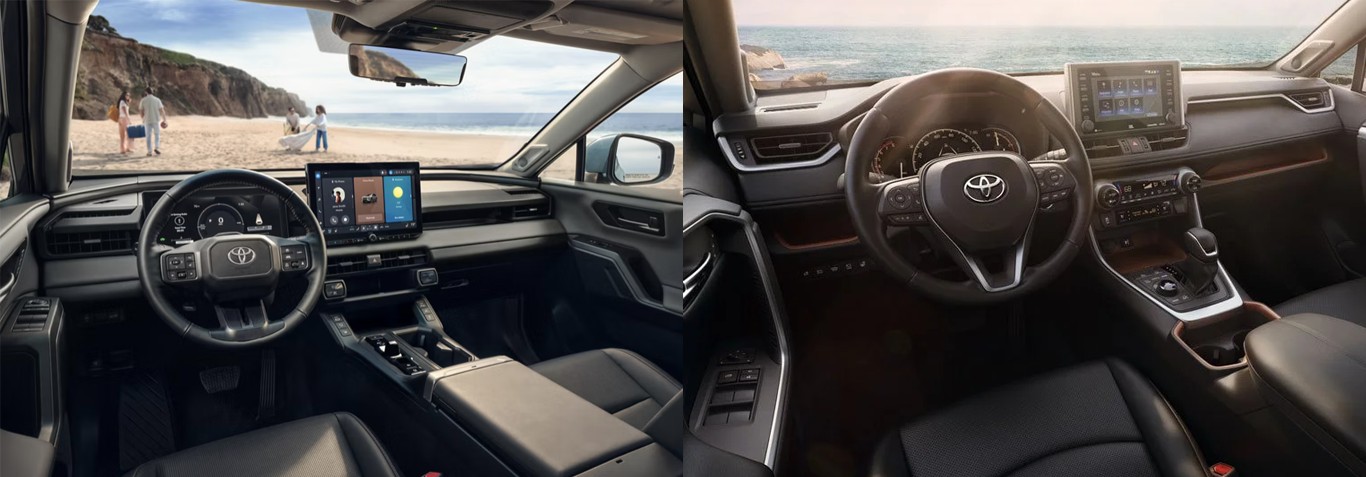 Interior comparison — 2019 vs. 2026 RAV4
The Tech Gap You Cannot Test Drive
Spend ten minutes in a 2026 RAV4 and the infotainment system is the thing that will move you. The 2019 shipped with a 7 or 8 inch screen running Toyota's old Entune software, which was competent in 2019 and embarrassing now. The 2026 gets a 10.5 inch screen standard and a 12.9 inch on higher trims, wireless CarPlay and Android Auto, and a cabin that actually feels like it was designed after smartphones existed.
TSS 4.0 is the other real upgrade. The 2019's adaptive cruise did not do stop-and-go. The 2026's does. If you sit in traffic every day, that one feature is worth more than most people budget for when they think about what a new car gets them.
What you are trading against this is the big physical climate dials the fifth generation had. The 2026 replaced them with touchscreen controls. Temperature buttons remain physical, which is something. But the dials you could twist without looking are gone, and that will irritate you on the tenth day of ownership, not the first.
Should I Trade In My 2019 RAV4 for the 2026 Hybrid?
Here is the part the dealership will not frame clearly. A 2019 gas RAV4 in decent shape is still a desirable used vehicle. Hybrid 2019 RAV4s hold about $2,500 to $4,000 more than gas equivalents at trade-in, which tells you where the market is headed. Your 2019 gas model is worth real money today and will be worth less every month going forward as hybrid inventory dilutes the used market.
If you are going to upgrade in the next twelve months, the math argues for doing it sooner. If you are going to keep driving the 2019 for another four years, the trade-in question resolves itself. The hybrid RAV4 supply will be larger, the gas RAV4 will be further into obsolescence, and the decision will be easier because there will be less to give up.
The question is not whether the 2026 is better. It is. The question is whether your 2019 has more life in it than you are giving it credit for.
Which Upgrade Path Makes Sense for a 2019 Owner?
If your 2019 is paid off and running clean, drive it another two years. The market shift is still early, used hybrid supply is still constrained, and you have time. Keep an eye on your fuel bill. If it crosses a number that actually bothers you, that is your signal.
For the owner already shopping, the XLE Premium AWD is the sweet spot in the 2026 lineup, same as I called it in the full review. Heated seats, wireless charging, power liftgate, and you get most of what makes the 2026 genuinely better without paying Limited money for features you will not use. Expect about $37,500 before destination.
If you want a real jump in performance, skip the hybrid and go PHEV. At 324 horsepower and a 5.6 second 0-60, it is a different vehicle than the hybrid you are upgrading from, not a polished version of it. If you can charge at home and your commute fits within 50 electric miles, the economics make the premium defensible within eighteen months.
If you drive 8,000 miles a year and the 2019 still feels like new, nobody needs to upgrade. The 2026 is better. The 2019 is fine. Those are not the same problem.
The Verdict Nobody Gave You
The 2019 RAV4 was a good car built at the end of an era. The 2026 is the start of a different one. Toyota is not asking if you want a hybrid. They have already decided. Your only real choice is whether you want to be in a Toyota at all.
For most 2019 owners, the answer will still be yes. The 2026 is a better vehicle in every measurable way, and the hybrid premium is smaller than the fuel savings over a normal ownership period. What you lose is the mechanical simplicity of a gas engine and a conventional transmission. What you gain is a car that does more with less.
The 2019 was the last good gas RAV4. The 2026 is a different bet. Pick which one you are making.