My surrogate parents drove big six-cylinder S-Class Mercedes through the 1980s. Replaced on something like a four-year cycle, the way people who had genuinely arrived somewhere drove the car that confirmed it. They eventually moved to the BMW 7 Series, then the 5. But before the BMWs, there was the S-Class, and it set the reference point that everything else got measured against for the rest of my automotive life.
Every vehicle I've cared about since has been judged, somewhere in the back of my head, against what that car was. The S-Class in the 1980s was the automotive standard of civilization. It didn't need to be explained. If you wanted the finest car available and you were done shopping, you bought one.
I've spent the last several months looking at W221 S550 listings. I keep telling myself the purchase is practical. Emily, who would prefer a sensible SUV, is waiting to see which way this resolves. The rationalization, for the record, holds up. Here's the case.
The W221 ran from 2007 through 2013. It sold new as a rolling argument for what Mercedes could accomplish at the top of the market, and it has since depreciated to the point where a clean example sells for less than a base Corolla. That gap between what it was and what it costs now is the entire point of this piece.
Buy the W221 S550 if you can budget $3,000–$5,000 beyond the sticker for initial maintenance work and you're going in with a pre-purchase inspection. The sweet spot is a 2011–2013 example, 70,000–100,000 miles, with documented Airmatic service or recent suspension work. Skip anything under $10,000. It's priced there for a reason. Walk away from any example without service records. The right W221 at $15,000 is a car that cost $87,000 new and drives like it hasn't forgotten that.
What $15,000 Gets You in This Market
A new base Toyota Corolla starts around $23,000. A used Camry with 60,000 miles lands somewhere between $18,000 and $22,000 depending on trim and the dealership's confidence in itself. A new base Honda CR-V Hybrid is $35,000. These are all sensible vehicles. None of them were engineered as the finest automobile that one of the world's most respected manufacturers could produce in a given decade.
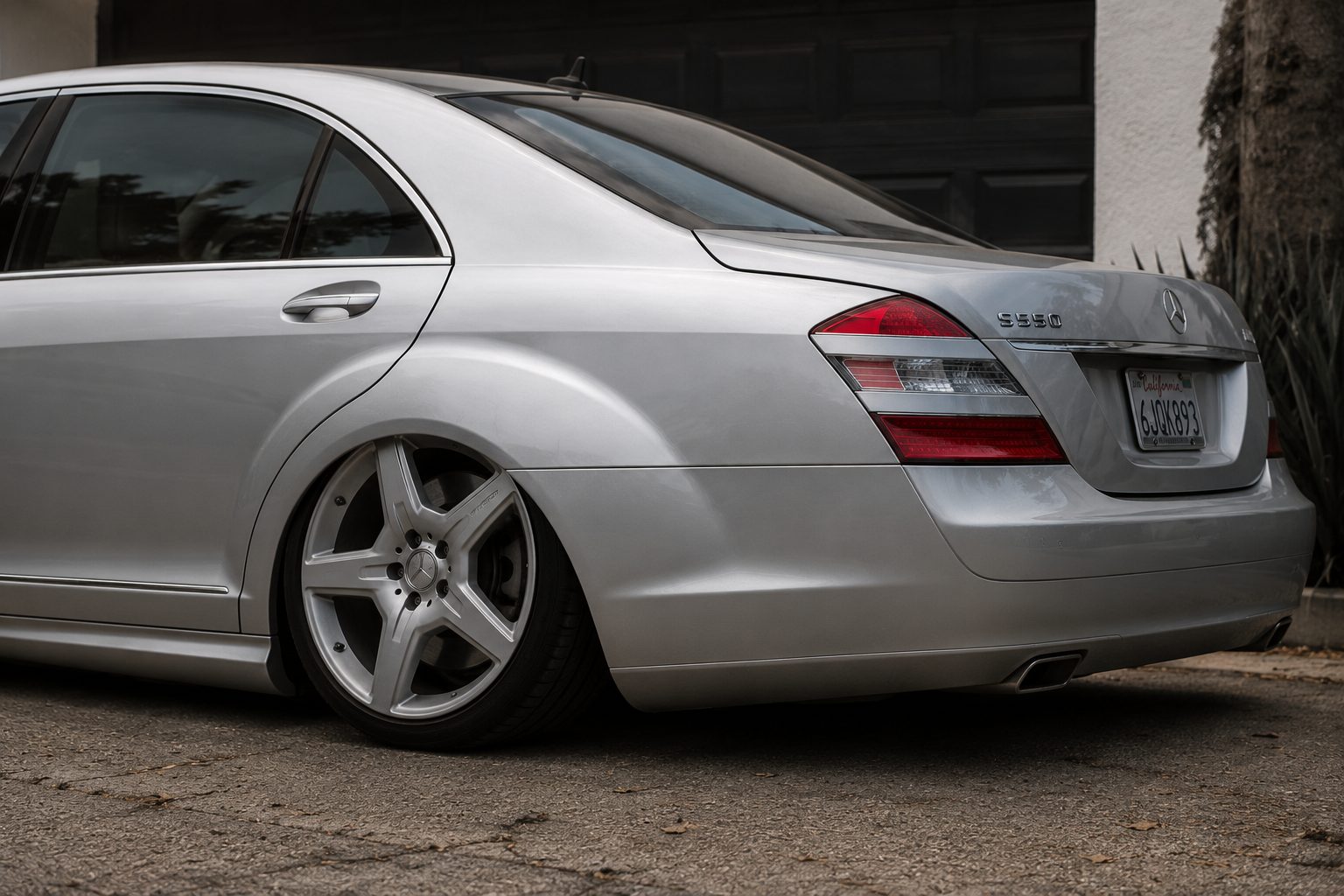
The 2011 Mercedes S550 was. It shipped with a 5.5-liter V8, Mercedes' M273, producing around 382 horsepower and paired to a 7-speed automatic. Rear-wheel drive standard, 4Matic all-wheel drive available. Original MSRP in the neighborhood of $87,000 to $95,000 depending on options, which means the car sitting on a private-party listing at $14,500 represents roughly 83 percent depreciation from its new price.
Depreciation is not charity. The W221 has a reputation to manage. But the reputation is mostly about one system, and that system is addressable.
The Airmatic Reality
The S550 rides on Mercedes' Airmatic suspension. Air springs, an onboard compressor, adaptive damping adjusting continuously based on road conditions and driving mode. In 2007, this was the best-riding car you could buy at any price. In 2026, with 80,000 or 100,000 miles on the clock, it is a system with a maintenance interval that most original owners never bothered to keep.
The compressor is the component that fails. When it does, the car sags. The ride quality disappears. And you are looking at a repair bill between $800 and $2,500 depending on whether the compressor alone is the problem or whether the air struts have also given up.
 The Airmatic compressor — the component most original owners never maintained
This is not a reason to avoid the car. It is a reason to ask a direct question before you buy. Has the Airmatic been serviced, and can you document it? A seller with records for compressor service or strut replacement is selling you a car that has already cleared this hurdle. A seller who doesn't know what Airmatic is, or who tells you "it's fine, I haven't had any problems," is selling you a deferred repair that will find you inside six months.
Get a pre-purchase inspection from an independent Mercedes specialist. Not a general shop. Someone who works on these cars and can put the system on a lift and tell you what is marginal and what is solid. Budget $150–$200 for the inspection. It is not optional.
The Mileage Framework
Under 60,000 miles at $15,000 is a flag before it's a green light. A 15-year-old car with unusually low mileage either sat for long stretches, came out of a fleet, or has history the seller is being selective about. Pull the Carfax. Low mileage on an older car is not a bonus. Seals dry out, fluids degrade by age as much as by use, and a car that spent five years in a garage has its own maintenance story that has nothing to do with the odometer.
60,000 to 100,000 miles is the go zone. Most mechanical systems are still in range, the Airmatic is approaching its service interval but hasn't necessarily failed, and the engine and transmission have enough miles on them to have surfaced any early problems without being into the territory where things wear out simultaneously. This is the mileage range where a pre-purchase inspection returns the most useful information.
100,000 to 130,000 miles is conditional. The Airmatic compressor is statistically likely to need attention here, and a number of other systems are approaching end-of-life concurrently. A 110,000-mile W221 with documented Airmatic service and clean records is still a reasonable purchase. Negotiate accordingly. A 110,000-mile W221 with no records and a seller who "hasn't had any problems" is a $10,000 car being offered at $15,000. Price it into the offer or walk.
Above 130,000 miles, the math at $15,000 stops working. The reserve budget required to bring a high-mileage car to reliable operating condition approaches the gap between what you'd pay for a better example. The right price for a 135,000-mile W221 without exceptional documentation is somewhere between $7,000 and $9,000. If someone is asking $15,000 for one, they either don't know this or they're hoping you don't.
What It Costs to Own
This is where the honest conversation happens, because the W221 is not a zero-maintenance proposition and the people who get burned bought on sticker price without running the actual number.
Add $2,000 to $4,500 on top of sticker in the first year, minimum. A pre-purchase inspection runs $150–$200 and is not optional. Initial fluid services run $600–$900 at a Mercedes specialist. The V8 has 16 spark plugs and replacing them is labor-intensive; budget $400–$600. Two batteries, main and auxiliary, need to be tested and replaced if marginal — that runs $300–$450 for the pair. If the Airmatic hasn't been addressed, add $800–$2,500 depending on what the inspection found. Miscellaneous first-year items add another $200–$400. At the low end of a clean example, you're into the car for around $17,000. At the high end, closer to $19,500.
Year two onward runs $1,700–$2,400 annually for an owner doing it right. Two oil changes ($300–$400), a routine maintenance reserve ($600–$800), and a budget for the thing you didn't see coming — because on a 15-year-old car there will always be one — should run $800–$1,200 per year.
Now run that against the alternative. A new Camry at $28,000 financed over 60 months is around $550 per month, $6,600 per year before insurance and maintenance. A new CR-V Hybrid at $35,000 is $680 per month, $8,160 per year. Over five years, the Camry buyer has written $33,000 in payments alone. The CR-V buyer has written $40,800. Neither car was engineered to be the finest automobile available at any price in any given decade.
The W221 buyer who pays $15,000, puts $4,000 into Year 1, and spends $2,000 per year afterward has spent $27,000 over the same period. In a car that cost $87,000 new and still behaves accordingly.
The tail risk is a catastrophic failure. Timing chain, transmission, or cascading electrical issues from years of deferred work. That turns a $15,000 purchase into a $22,000 one. A clean inspection and a seller with records reduces this risk substantially. It does not eliminate it. You are accepting more uncertainty than you would with a new car warranty. What you are being compensated with is the difference between a $550 monthly payment and none.
Insurance is also worth noting. A 15-year-old car at $15,000 book value costs significantly less to insure for collision and comprehensive than a new vehicle at $35,000. That delta, compounded over five years, adds several thousand dollars back to the W221's side of the ledger.
What to Look For
The M273 V8 is not the problem. It is a durable engine with no catastrophic known failure modes in the mileage range where these cars are selling. Timing chain stretch is a consideration above 150,000 miles, not a concern on a 90,000-mile example with regular oil changes. The engine will outlive most of the systems around it.
The COMAND infotainment system is dated. It works. Navigation maps are outdated and not worth updating. Use your phone. The audio system in a well-equipped W221 is genuinely good, and the physical controls are laid out the way physical controls are supposed to be laid out. Buttons for everything, nothing buried three menus deep, climate control you can operate without looking at the screen. This is not a trivial advantage.
Sunroof drains clog. On a 15-year-old car, clogged sunroof drains lead to water intrusion, which leads to wet carpets, which leads to electrical issues, which leads to a cascade you do not want. Ask whether the sunroof drains have been serviced. If the seller doesn't know what you're asking about, factor it into your offer or your inspection checklist.
The interior tells you how the car was treated. W221 leather holds up well when it's been conditioned; it shows neglect quickly when it hasn't. A car with cracked driver's seat bolsters and a worn steering wheel has been driven hard and maintained rarely. A car with clean leather and a wheel that still has texture has been owned by someone who knew what they had.
 W221 interior — the leather tells you everything about how the car was owned
Skip the AMG variants at this price point unless you specifically want the project. The S63 and S65 use Active Body Control instead of Airmatic, hydraulic active suspension that is significantly more expensive to service and significantly less forgiving when it fails. An S550 at $15,000 is a calculated purchase. An S63 at $15,000 is a commitment.
The Buy Case
You are buying 83 cents of every dollar of depreciation that someone else absorbed. The engineering is not 83 percent worse. The ride quality, the cabin, the V8, the sense of occasion when you close the door — none of that depreciates at the rate of the sticker price. What depreciates is the novelty, the warranty, and the assumption that someone else is responsible for the maintenance.
 The W221 at $15,000 — 83% depreciated from new, none of the engineering went with it
At $15,000 with a $3,000–$5,000 reserve, you have a car that will operate correctly, ride at a standard no new vehicle at this price approaches, and return the kind of highway cruising experience that was worth $87,000 when it was new. The road noise suppression in a clean W221 is still better than most new midsize sedans. The seats are still better. The presence is still there.
This is what my surrogate parents understood about the S-Class when they drove them in the 1980s. The car knew what it was. At $15,000, it still does.
The Skip Case
Skip it if you need zero-surprise ownership. The W221 will have deferred maintenance items. A well-priced example at this age always does. If your budget does not include a reserve for what the inspection finds, you are not buying a $15,000 car. You are buying an $18,000 car and hoping to pay $15,000 for it.
Skip it if you are buying on price alone from a private seller with no service history. "Runs great, no issues" is the description of a car where the seller is not certain what the issues are. Service records are not a negotiating point. They are the difference between a calculated purchase and a gamble.
Skip it if the Airmatic has not been addressed and the seller is not pricing the repair into the offer. A car with a sagging rear on cold mornings and a compressor on borrowed time is a $10,000 car, not a $15,000 car.
For the buyer who can work through these filters, the W221 S550 is the clearest value proposition in used luxury right now. It is a better car than most of what you can buy new at twice the price. The people who get burned on these cars skipped this section.
For the full picture on what makes the W221 worth caring about in the first place, the review is here.
Frequently Asked Questions
Is the 2011 Mercedes S550 reliable?
The M273 5.5-liter V8 is a durable engine with no major known failure modes in the 70,000–120,000-mile range. The primary reliability concern is the Airmatic suspension system, specifically the compressor, which fails on high-mileage examples that haven't had it serviced. A pre-purchase inspection by a Mercedes specialist is not optional.
What is the biggest problem with the Mercedes W221?
Airmatic suspension failure is the most common and most consequential issue. The compressor and air struts wear out, typically between 80,000 and 120,000 miles, and the repair runs $800–$2,500 depending on what's needed. Sunroof drain clogs and COMAND infotainment failures are secondary issues. The engine itself is generally sound.
What year W221 S550 should I buy?
The 2011–2013 models, post-facelift, are the sweet spot. They have the updated front fascia, revised interior trim, and any early production issues resolved. Avoid the 2007–2008 first-model-year examples unless the service history is exceptional.
How many miles is too many for a W221 S550?
The go zone for a $15,000 purchase is 60,000–100,000 miles. From 100,000 to 130,000, the car is still buyable with documented Airmatic service and records. Negotiate the deferred maintenance into the price. Above 130,000 miles, the math at $15,000 stops working. The right price for a high-mileage example without exceptional documentation is $7,000–$9,000, not $15,000. Under 60,000 miles on a 15-year-old car warrants scrutiny — ask why it's that low before treating it as a bonus.
Should I buy an S550 or S63 AMG at this price?
Buy the S550. The S63 and S65 AMG variants use Active Body Control suspension instead of Airmatic, hydraulic active suspension that is significantly more expensive to repair. At a $15,000 price point, the AMG variants are a project. The S550 is a purchase.
What should I pay for a 2011 Mercedes S550 in good condition?
A clean 2011–2013 S550 with documented service history, under 100,000 miles, and no known suspension issues should run $13,000–$18,000 depending on trim and market. Budget an additional $3,000–$5,000 for initial maintenance work regardless of condition. At 13 years old, there will be deferred items. A pre-purchase inspection will tell you specifically what you're looking at.