When we were in high school, my friend Robert asked me to draw him a Cadillac Eldorado convertible.
I loved drawing cars, so I said sure. Side profile. White body. Lipstick-red interior. The sort of car that looked as if it should arrive with a deed to South Florida and a divorce lawyer in the glove box.
I liked the drawing. I hated the car.
I was interested in BMWs, Mercedes and Maseratis then. Those cars seemed to understand that size had to accomplish something. The Eldorado was 224 inches long, and much of that length appeared to have been set aside for the hood to arrive before the passengers did.
It belonged to 1976, though its philosophy survived well into the 1980s, when bigger meant richer and efficiency was for people who had to ask what it cost.
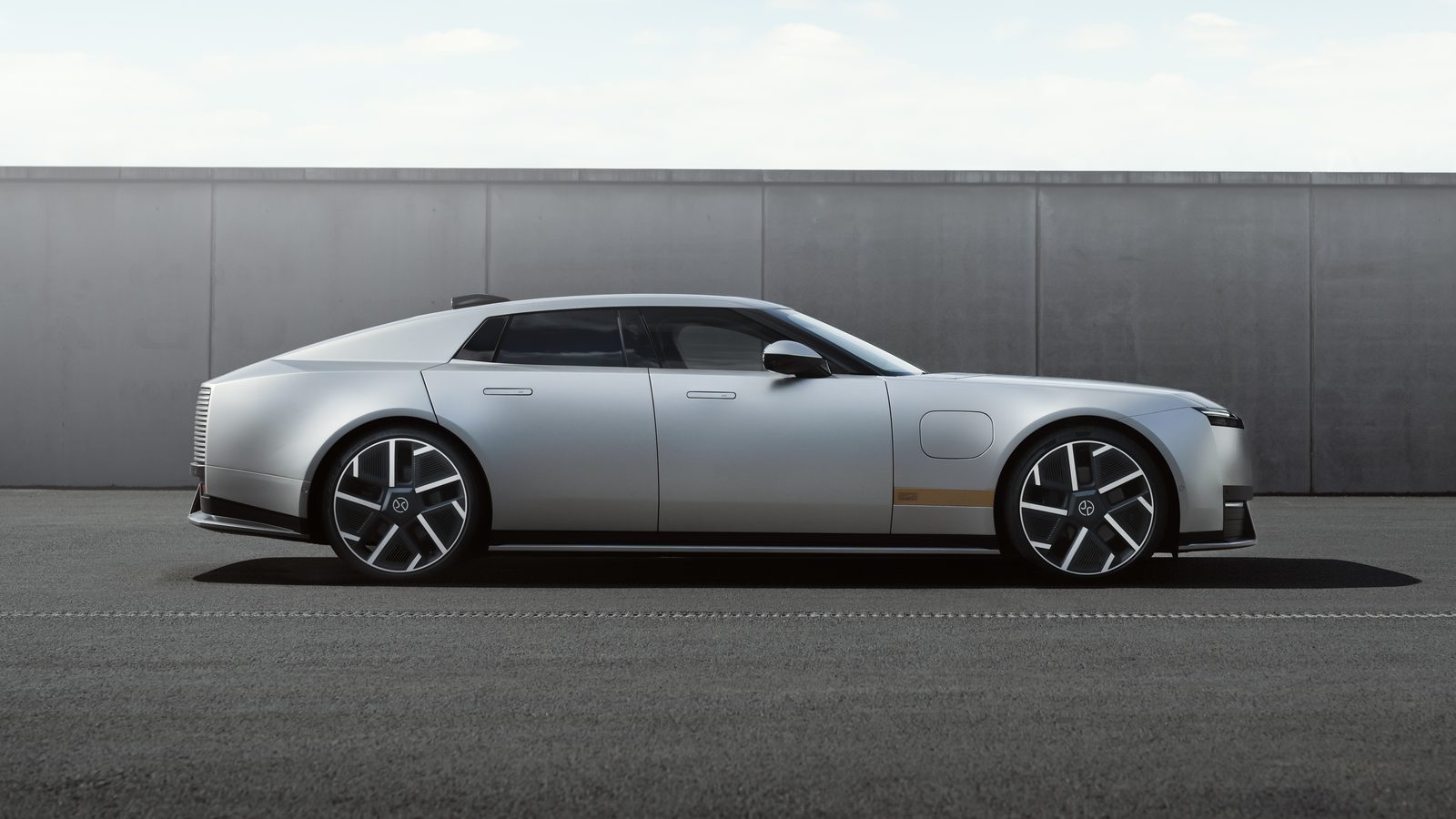
The new Jaguar Type 01 understands this perfectly. It just hasn't noticed that the 1980s ended.
A very large way to seat four people
The Type 01 is 206 inches long. It has four doors and four seats.
Car and Driver got inside the production car at its New York unveiling and found rear door openings that were difficult for a larger adult to negotiate. Once inside, the low roof and the spine running down the center made the cabin feel tighter than the bodywork suggests.
The front passenger doesn't escape the architecture. A structural casting pushes into the footwell, leaving a tall passenger to choose between raised knees and feet against a wall.
That takes work in a car more than 17 feet long.
There is no rear window, which you might assume gave Jaguar room for a generous trunk. It didn't. The rear drive hardware sits above the axle, and Car and Driver reports space for one or two checked bags.
Even the charging door had to grow because a normal-sized one looked too small against the fender.
Jaguar has built a car so large that its fuel door needed visual ballast, then made the passenger compartment feel intimate. Cadillac would have understood.
Lucid found the missing inches
The Lucid Air is 195.9 inches long, about ten inches shorter than the Jaguar. It seats five.
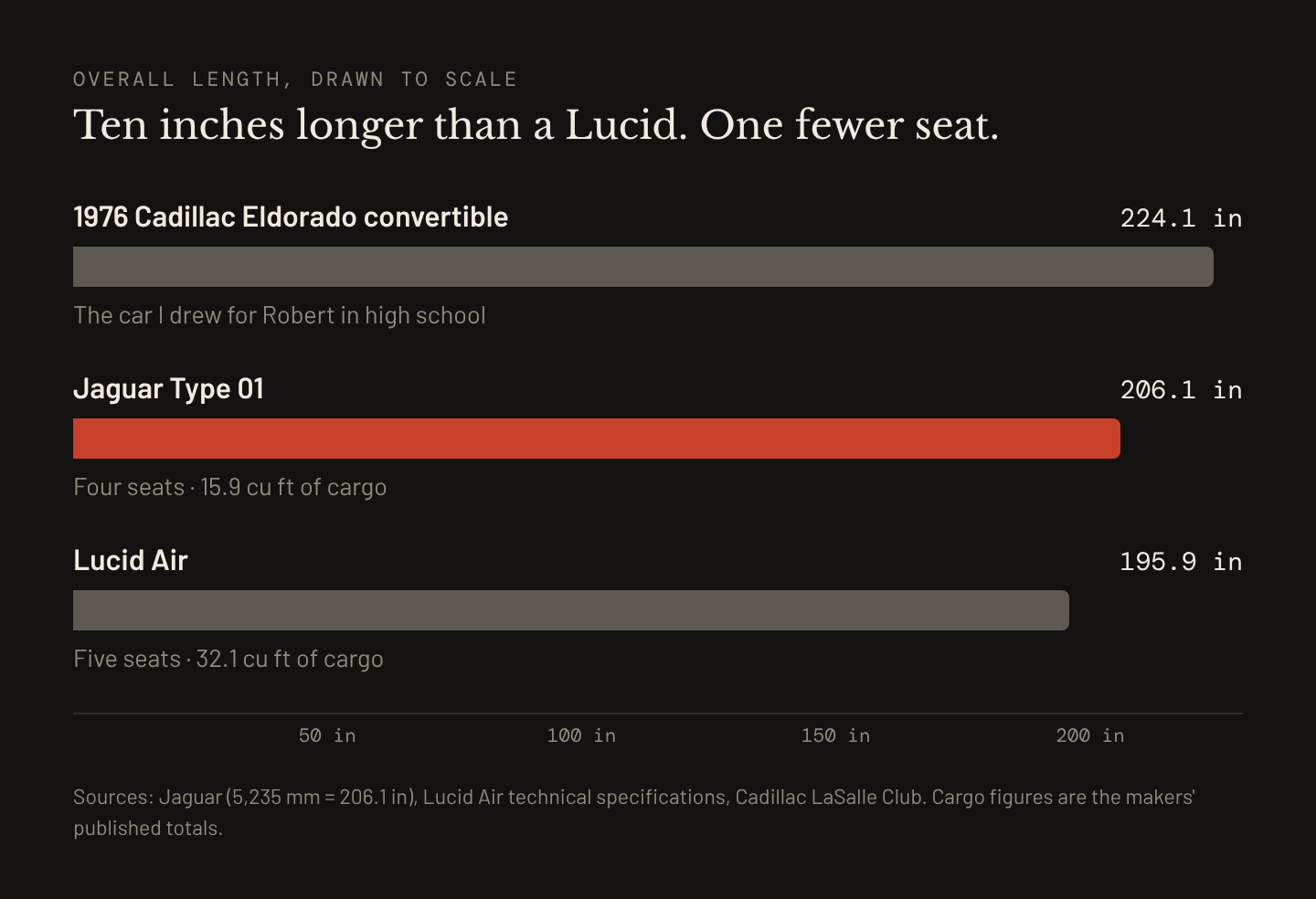
Lucid lists 100.7 cubic feet of passenger room and 32.1 cubic feet of cargo space between the trunk and frunk. The compact motors and battery hardware were designed around the useful space rather than treated as obstacles to a styling exercise.
I've driven the Air. It is amazingly quick and almost unnervingly quiet, which is what you expect from a serious luxury EV. What you don't expect until you get inside is the room. The body has large bones, but the cabin feels like a ballroom.
The Air already delivers Jaguar's old promise of grace, space and pace. It is elegant, roomy and indecently fast. In that sense, it may be a more authentic modern Jaguar than the Type 01.
Lucid used electric propulsion to rethink what a large luxury sedan could do for the people inside it, and Jaguar spent the same opportunity on the hood.
Jaguar could have bought much of the answer. Lucid already supplies electric technology to other carmakers. Aston Martin signed an agreement worth more than $450 million for access to Lucid's motors, battery systems and charging hardware, along with help integrating it into Aston Martin's own electric platform.
So this would not have been as simple as putting a leaper on an Air and changing the leather. Jaguar would still have needed to engineer its own body and chassis. But Aston Martin proved that a British luxury brand could buy the mature electric hardware and spend its time making the finished car feel like itself.
How much money would Jaguar have saved by doing the same? We cannot know from outside the company. Enough to make the question uncomfortable.
Jaguar chose to build an entirely new electric architecture. The result is ten inches longer than the Lucid, holds one fewer person and uses its size less effectively. At some point, independence starts looking like expensive vanity.
The Type 01 counters with 1,015 horsepower, a provisional 400 miles of range and enough screens to reassure everyone that electricity was involved. The main display measures 24 inches. Each row gets another seven-inch screen for climate and seat controls.
The car may deny its occupants glass and footroom, but nobody will suffer from a shortage of menus.
The Jaguar everyone hoped for
Ask around. The people still interested in Jaguar weren't asking for a battery-powered museum piece. An electric XKE should not be an old shape with a charging socket drilled into it.
They were hoping for the same idea that made the E-Type matter. It was long, low, sinuous and unmistakably a Jaguar. The shape had drama because it had discipline. Every line seemed to be going somewhere.
Electric architecture gave Jaguar freedom the old engineers never had. The company could have used that freedom to make something sexy and groundbreaking again. Something that looked like desire had learned to run on electrons.
Instead, Jaguar spent the freedom on an ornamental hood, a low roof, a center spine and four people sitting inside a 206-inch monument to 1980s personal luxury.
The strange part is that the Type 01 may drive beautifully. The early prototype reports were encouraging. Its rear steering should make the size easier to manage, and the powertrain numbers are serious.
But no amount of steering or horsepower makes a rear door opening larger, and a 24-inch screen can't tell your feet where to go.
Jaguar says the car is supposed to be exuberant. Fine. The Eldorado was exuberant too.
It gave you acres of sheet metal, a white convertible top and an interior the color of a cocktail waitress's lipstick. Nobody mistook restraint for the point.
The difference is that Cadillac built that car fifty years ago.
Robert would probably love the Type 01. I would probably draw it for him.
I'd need a wider sheet of paper.
Source notes
- Type 01 cabin access, passenger footwell intrusion, center spine, screen layout, rear cargo limitations, charging-door scale and rear-steering details are from Car and Driver, based on its inspection of the production car at the New York unveiling.
- Jaguar specifications, including the 5,235 mm length, four-seat layout, power and provisional range, are from the JLR US release and JLR global release. Jaguar's US release also lists 208 inches, but 5,235 mm converts to 206.1 inches.
- Lucid Air dimensions and interior volumes are from Lucid's Air Pure technical specifications. Lucid lists a 195.9-inch length, seating for five, 100.7 cubic feet of passenger volume and 32.1 cubic feet of combined trunk and frunk capacity.
- Lucid and Aston Martin announced a technology and supply agreement worth more than $450 million covering Lucid powertrain and battery technology, components and integration support. Aston Martin retained its own bespoke EV platform. Sources are Lucid and Aston Martin.
- The 1976 Cadillac Eldorado's 224.1-inch length and 126.3-inch wheelbase are documented by the Cadillac LaSalle Club. Hagerty's 1976 Eldorado convertible guide documents the body style and 500-cubic-inch V8.
- Hero image: Jaguar press photography, JLR Media. Length graphic: CreativeGuySteve, drawn to scale from the sources above.