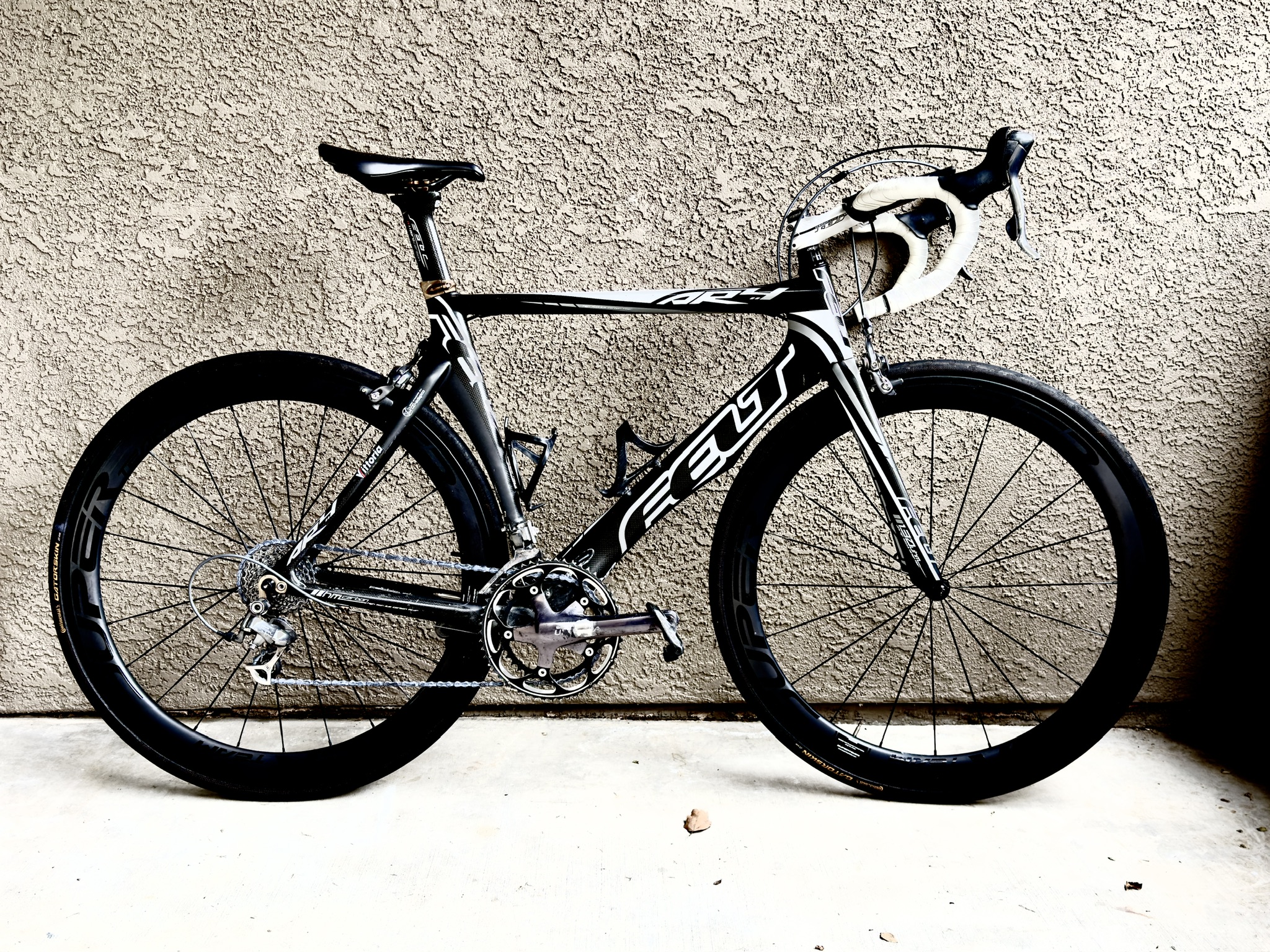
I have a bike that's old enough to vote.
The Felt AR4 leaning against my garage wall was new in 2008. Carbon fiber, lithe as a greyhound, fast as a bad decision. Over 100,000 miles on it now. Replaced the rims a couple of times, chains and sprockets, the usual wear items. Everything else is original.
It's taken me to some places. The Belgian Waffle Ride — 150 miles, 11,000 feet of climbing, eight hours in the saddle, which is as brutal as it sounds and then considerably worse. Countless 120-mile days down the coast to San Diego and back, through every hill South Orange County can come up with, which turns out to be quite a few. For years it was my commute: 76 miles round trip, North OC to home, through those same hills, both ways, every day. I've watched more SoCal sunsets from that saddle than I could accurately account for.
If someone wanted to give me a new bike, I wouldn't say no. But the Felt hasn't given me reason to ask.
Age and Will
I read recently about a man who, shortly after turning 85, rode 3,007 miles from San Diego to St. Augustine, Florida in 44 days. On a Schwinn Varsity 10-speed he bought 50 years ago. My first thought was admiration. My second was: of course he did. Age matters less than will, and will is something you either develop or you don't. My mother is 87 and still exercising. I'm fairly convinced that's not entirely separate from my own ability to occasionally embarrass someone forty years younger on a climb. Genetics hands you the cards. But you still have to play them.
Endurance cycling teaches things that don't show up on a resume and appear everywhere else. You learn that pain is information, not a stop sign. You learn that the voice telling you to quit is a liar who sounds reasonable, especially around mile 90. You learn to be honest about your actual state — not the state you'd prefer to be in — because miscalculating on a long climb in the desert has consequences that aren't theoretical. And you learn that showing up, day after day, before the sun, through hills, both ways, is how things actually get built. Not inspiration. Not the right conditions. Showing up.
These are not abstract virtues. They are operating principles, and they transfer.
What This Has to Do With You
I've been a working writer and creative director for a long time. The discipline that got me through eight hours on Belgian gravel is the same discipline that keeps a client's project moving when the brief falls apart, the stakeholders disagree, and the deadline doesn't care that any of this happened. The ability to sustain a productive internal conversation under pressure — not panicked, not falsely cheerful, just honest and pointed forward — is genuinely rare. You don't develop it in a seminar. You develop it somewhere long and hard, usually alone, with no one watching.
There are a lot of us out here. Experienced professionals who also happen to be athletes. Some of us freelance. Some of us are looking for positions at your company. Many have been doing hard things for a long time and have found out, in the process, exactly what they're made of.
Companies miss this. The instinct runs toward youth and speed, and speed is fine when speed is what you need. But most companies need someone who can sustain. Who can adapt under load. Who has enough accumulated judgment to know when a problem is serious and when it just feels that way at 2am. Who won't fold when the road gets long and the results haven't shown up yet.
Are You Coming?
The Felt AR4 doesn't know it's 2026. It doesn't know it went to market the same year the first iPhone did. It knows the road, and the hills, and the long quiet mornings before anyone else is awake. Ask it to work and it works. Same as it ever did.
I like to think — and we anthropomorphize our things, I'm no exception — that it wakes up every morning with the same question: are you ready? We've got places to go. Are you coming?
That's what I'm asking you. We may have some miles on us, but we bring something to your company that takes a long time to develop and doesn't cost you what it saves. Experience. Depth. The specific kind of honesty that comes from having made the hard call before and lived with the result.
We're here. We're ready. You just have to know what you're looking for.
Off-Spec: The Automotive Intelligence Brief
OEM strategy, fleet economics, and the business of how cars actually get sold. No press releases. No puff pieces.